

Breast augmentation is rarely a spur of the moment decision. Most women think about it for a long time, research it, set it aside, and return to it more than once before scheduling a consultation. That back and forth is normal, and it usually reflects a gap in information more than a lack of certainty. Here’s what you need to know to move forward with a clear answer.
Breast augmentation remains one of the most performed cosmetic surgeries in the world. According to the ISAPS, surgeons performed over 1.65 million breast augmentations globally in 2024, making it the third most popular surgical procedure worldwide.
That said, the numbers tell an interesting story. Global procedures dropped 17.5% from 2023, when over 2 million were performed. That shift isn’t a sign the procedure is losing appeal. It reflects a growing trend toward more thoughtful, research-driven decisions, with patients taking extra time to find the right surgeon and the right approach for their body.
At Cosmetic Surgery Affiliates in Oklahoma City, our board certified breast augmentation surgeon team believes every patient deserves a balanced, honest picture before making this choice. This article will walk you through the genuine benefits, the real trade-offs, recovery realities, costs, complication rates, and the questions you should be asking yourself and your surgeon. By the end, you’ll have the clarity to decide whether breast augmentation truly aligns with your goals.
5 Things You Should Know About Breast Augmentation Before Deciding
- Breast augmentation has real, research backed benefits and real trade offs, and neither side should be minimized when making your decision.
- Your personal priorities, including appearance goals, health status, lifestyle demands, and budget, determine whether this procedure is right for you.
- Timing matters more than most people realize. Life circumstances like pregnancy plans, career demands, and financial stability all affect both candidacy and long term satisfaction.
- The “right” decision looks dramatically different from person to person, and what works for a friend or someone online may not be the best fit for your body or your life.
- Breast augmentation surgery is a big choice, one that needs time, thorough research, and self-reflection for the best outcome.
What Are the Real Benefits of Breast Augmentation?
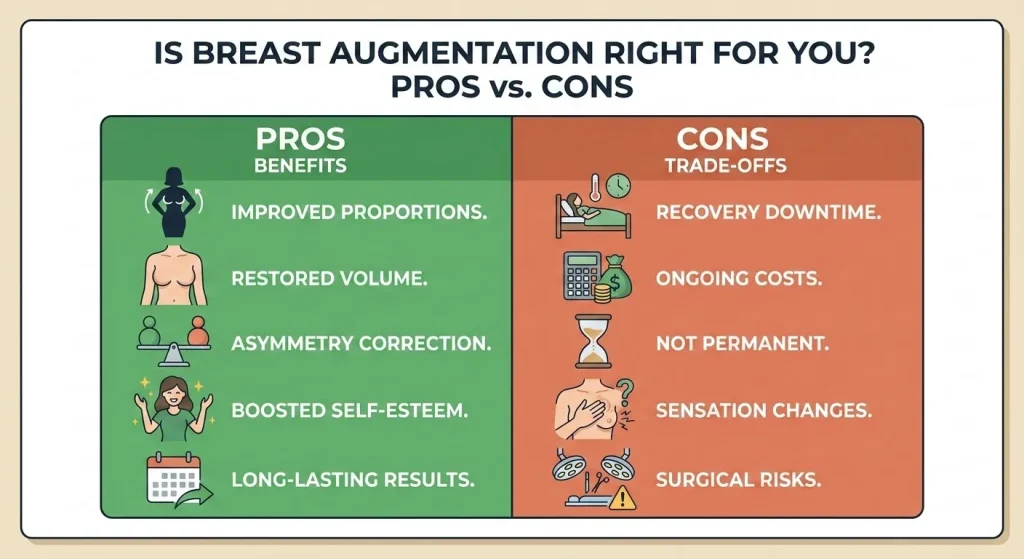
The benefits of breast augmentation go beyond appearance, though that’s understandably where most patients start. When your body feels proportional and balanced, it changes how you move through the world, from the way clothes fit to how confident you feel at the pool.
Here are some gains that you will directly experience:
| Benefit | What It Means for You |
| Improved body proportions and clothing fit | Many women find they can finally wear tops, dresses, and swimwear without alterations or padding — clothes simply fit the way they’ve always wanted them to |
| Restored volume after life changes | For patients who’ve lost fullness after pregnancy, breastfeeding, or significant weight loss, augmentation can feel like reclaiming a part of themselves that was lost |
| Asymmetry correction | Most women have some degree of natural asymmetry, but when the difference is noticeable enough to affect clothing choices or self-confidence, augmentation can create a more balanced, even look |
| Improved self-esteem and body image | A five-year clinical study published in Plastic and Reconstructive Surgery found that 92% of patients reported improved self-esteem and 64% reported an improved quality of life after augmentation |
| Long-lasting results | Modern implants typically last 10 to 20 years, making breast augmentation one of the longer-lasting cosmetic investments available |
You don’t have to guess whether these benefits would apply to your situation. A consultation gives you the chance to discuss your specific goals with a board certified surgeon who can show you what results are achievable for your specific anatomy, including size range, shape options, and any limitations to be aware of.
What Are the Downsides You Should Know About?
No surgery is without risks, and being honest about them upfront is what separates a well informed decision from a regretful one. The downsides of breast augmentation shouldn’t scare you away from looking into it, but they are factors that deserve your full consideration.
Like any surgical procedure, breast augmentation carries risks including infection, bleeding, and adverse reactions to anesthesia. Recovery requires real time off. Depending on your job and daily responsibilities, you’re looking at anywhere from one to six weeks of reduced activity. That means arranging help at home, time away from work, and patience with your body.
- Cost is a significant consideration. Breast augmentation is almost never covered by insurance, and the total investment goes beyond the initial surgery. You’ll want to factor in potential future costs for replacement, revision, or imaging over the lifetime of your implants.
- Implants aren’t permanent. While modern implants can last 10 to 20 years, they may eventually need replacement or removal.
- Regular self exams and periodic imaging are part of the long term commitment.
- Changes in nipple sensation can also happen to some patients, which can be temporary or, in about 5- 15% of cases, permanent.
Sound familiar to you? These concerns are completely valid, and acknowledging them doesn’t mean augmentation isn’t right for you. It means you’re approaching the decision with the seriousness it deserves.
How Do You Know If the Benefits Outweigh the Risks for You Personally?
This is the question that really matters, and nobody can answer it for you. But a framework can help. Instead of trying to weigh abstract pros and cons, consider where you fall on these specific decision points.
| Consider Breast Augmentation If… | Reconsider or Wait If… |
| Your breast size or shape has bothered you for years | You’re considering it to please someone else |
| You’re in good overall health | You have uncontrolled health conditions that increase surgical risk |
| You’ve finished having children (recommended) | You’re currently pregnant, breastfeeding, or planning pregnancy within 6 to 12 months |
| You can afford the procedure and potential future costs | You’d need to go into significant debt or financial strain |
| You understand recovery requires 1 to 6 weeks off normal activities | You can’t take time off work or away from daily responsibilities |
| You’ve researched thoroughly and consulted with board-certified surgeons | You’re making a rushed decision or feeling pressured by someone else |
Take a moment with that table, there’s no wrong answer here. If most of your responses fall in the left column, augmentation may be a natural fit for where you are right now. If you find yourself landing in the right column on several points, that still doesn’t mean this isn’t for you. It may just mean the timing isn’t quite right, and honestly, recognizing that takes real self awareness.
Whatever you’re feeling as you read this is completely okay. The women who tend to feel happiest with their results aren’t necessarily the ones who felt the most certain at the start; they’re the ones who gave themselves permission to sit with the decision long enough to know it was truly theirs. Not their partner’s. Not social media’s. Theirs.
You deserve to feel confident in whatever you decide, and there’s no timeline on that. Learning why choose cosmetic surgery in OKC for your transformation is often what makes that confidence click for patients.
What Does Recovery Look Like, and What are Some Ways to Make it Easier?

Recovery is one of those things that’s easy to underestimate when you’re excited about your results, and that’s completely normal. But it’s worth taking a look at what your life will be like in the weeks after surgery. Will you have someone nearby to help out? Can work or family obligations flex enough to give you real time to rest? How do you typically handle discomfort?
These aren’t meant to be discouraging questions. They’re the kind of things that, when you plan for them ahead of time, can make the difference between a recovery that feels manageable and one that feels overwhelming. You deserve to go into this feeling prepared.
The first week is the most physically demanding. Most patients describe it as sore, tight, and fatiguing. You’ll need someone to drive you home after surgery, help with household tasks, and potentially assist with childcare if you have young kids. Pain is typically managed with prescribed medication for the first few days, then over-the-counter options.
Everyone’s recovery is a little different, but here’s a general timeline to help you plan around the things that matter most in your daily life:
| Activity | When You Can Resume |
| Desk work | 5 to 7 days |
| Driving | 1 to 2 weeks (once off narcotic pain medication) |
| Light housework | 1 to 2 weeks |
| Lifting children or heavy objects | 4 to 6 weeks |
| Upper body exercise | 4 to 6 weeks |
| High-impact cardio and running | 4 to 6 weeks |
| Full unrestricted activity | 6 to 8 weeks |
The first week is the most physically demanding part of the process, but it’s also temporary, and a little planning goes a long way toward making it manageable. If you can arrange to take a week off work, line up some help around the house, and have someone nearby for support, you’ll be setting yourself up for the smoothest recovery possible. Think of it as giving yourself the gift of a proper reset.
There’s also an emotional side to recovery that doesn’t get talked about nearly enough, and it’s worth being prepared for. In the early days, swelling can distort your initial results, your body feels unfamiliar, and it’s completely normal to have a moment where you think, did I make the right call?
If that happens, please know that almost every patient goes through this, and it almost always passes within a few weeks as the swelling goes down and your real results start to emerge. The version of your breasts you see at one week is not the version you’ll be living with.
How Much Does Breast Augmentation Cost?
The financial picture matters, and it’s more complex than a single price tag. At Cosmetic Surgery Affiliates, breast augmentation typically ranges from $6,500 to $9,000, though your final cost depends on factors like the type of implants you choose, anesthesia, and your individual treatment plan.
If that range feels wide, there’s a reason for it. The total cost of breast augmentation isn’t just one fee, it’s a combination of several separate charges that vary depending on your surgeon, your location, the type of implants you choose, and the specifics of your procedure. Understanding what goes into that number can help you compare quotes more accurately and avoid any surprises down the road.
We know the financial side can feel stressful, especially when you’re already making a big personal decision. It helps to break the costs into what you’re actually paying for.
- Surgeon’s fee (varies by experience and location)
- Anesthesia and operating facility fees
- Implant cost (silicone typically costs more than saline)
- Pre-op testing and post-op garments
- Follow-up appointments
When you’re comparing costs between surgeons, the most important thing you can do is make sure you’re comparing complete quotes, not just surgeon fees. A lower price tag that only covers part of the picture can end up being more expensive, and therefore more stressful, than an all inclusive quote that feels higher at first glance. Geographic location also plays a role in pricing, and costs in Oklahoma City may differ from coastal cities.
It’s also worth thinking about affordability in the bigger picture, because you deserve to feel financially comfortable with this decision, not just right after surgery, but in the years that follow. There are some longer term costs to be aware of, like the possibility of revision surgery down the road or periodic imaging to monitor your implants.
None of these are guaranteed expenses, but they’re worth factoring into your planning so nothing catches you off guard. The goal isn’t just to be able to afford breast augmentation, it’s to be able to afford it in a way that feels good, where you’re investing in yourself without sacrificing the other things that matter to you. That kind of financial peace of mind is part of what will make the whole experience a positive one.
What Are the Most Common Complications, and How Likely Are They?
Reading a list of potential complications can feel scary, but understanding them is actually one of the most empowering things you can do. Knowledge doesn’t create fear, it replaces it with preparedness. Here’s what the data actually shows.
| Complication | Likelihood | What It Means |
| Capsular contracture | 8 to 18% lifetime risk | Scar tissue around the implant tightens and hardens, potentially requiring surgical correction |
| Implant rupture or leakage | Risk increases over time | Modern implants are durable, but may eventually fail. Silicone ruptures are often only detectable by imaging |
| Changes in nipple sensation | About 15% permanent | Temporary numbness or hypersensitivity is common. Most sensation returns fully during recovery |
| Infection | 2 to 2.5% of cases | Typically treatable with antibiotics |
| Asymmetry or aesthetic dissatisfaction | Varies | Minor asymmetry is normal. Significant concerns may require revision surgery |
| Need for revision surgery | About 20% within 8 to 10 years | Implants aren’t lifetime devices. Replacement, repositioning, or removal may be needed |
| BIA-ALCL | Extremely rare | An extremely rare condition that your surgeon screens for during follow-up visits. The risk is very low, and early detection leads to excellent outcomes |
Your individual risk depends on factors like your health, implant type, surgical technique, and how well you follow post-op instructions.
If these risks feel manageable given the potential benefits, you may be a strong candidate. If certain complications feel like deal-breakers, that’s equally valid information. Either way, discussing your specific risk profile with a board certified surgeon will give you a much clearer picture than just the statistics alone.
Is Now the Right Time, or Should You Wait?
Even if you already know in your heart that breast augmentation is right for you, when you do it matters just as much as whether you do it. And giving yourself space to think about timing isn’t hesitation, it’s smart. Here are some things to consider before you book your consultation:
- Life stage: Have you finished having children? Pregnancy and breastfeeding can significantly change your results.
- Career demands: Can you realistically take one to two weeks off, with lighter duties for several more?
- Financial stability: Can you afford the procedure without hardship, including potential future costs?
- Support system: Do you have someone to help during the first week of recovery?
- Emotional readiness: Have you thoroughly researched, consulted with surgeons, and feel certain this is your decision?
- Health status: Are you in good overall health and medically cleared for elective surgery?
Deciding that now isn’t the right time doesn’t mean never. It means you’re prioritizing the best possible outcome. Many patients wait months or even years between their initial research and their surgery date, and they’re often the most satisfied because they went in fully prepared.
Our patient, Kersten, describes her journey from research to post operation:
“From the beginning I started talking with Morgan she was great about reaching out and following my 1000 questions as well as being patient with me and helping me set up a virtual consult. My first visit in the office was to pick out a size implant I was looking for. The staff was very personable and made my experience professional and comfortable. I had my breast augmentation done with Dr. Nuveen yesterday, when I say I was blown away with his personality and level of wanting to meeting my expectations was greatly exceeded.”
What Happens During Consultations and What Questions Should You Ask?
A consultation isn’t just a formality. It’s your chance to evaluate the surgeon as much as they’re evaluating you.
During a typical consultation, your surgeon will review your medical history, examine your breast anatomy, discuss your goals, and walk you through your best options. Our detailed breast augmentation consultation guide walks through exactly what to expect and which questions to bring.
They might ask about implant types, sizes, placement, and incision locations. At Cosmetic Surgery Affiliates, our board-certified cosmetic surgeons take the time to build a custom treatment plan based on your unique anatomy and vision, so you can make confident decisions.
Moreover, the questions you ask can reveal important information about both the practice and your own readiness. Being prepared will help you get the most out of your appointment.
Questions about results:
- Based on my anatomy, what results are realistic?
- Can you show me before-and-after photos of patients with similar anatomy?
- What size and type of implant do you recommend, and why?
Questions about risks:
- What’s your complication rate for this procedure?
- How do you handle complications if they occur?
- What’s your revision rate?
Questions about experience:
- How many breast augmentations do you perform yearly?
- What board certifications do you hold, and what specialized training have you completed in cosmetic surgery?
- Where will my surgery take place, and is the facility accredited?
Questions about recovery:
- What will my recovery timeline look like specifically?
- When can I realistically return to work and normal activities?
Our surgeons at Cosmetic Surgery Affiliates welcome these questions and will answer them thoroughly because we respect your decision making process.
Our patient, Holley, can attest to this:
“I came in for my Breast Augmentation on 3-11-2025 and I am loving my results so far! Dr. Tessa Meyer gave me exactly what I asked for. Everyone there is so nice and helpful when it came to any questions I had about sizes, down time, and the surgery itself. 10 out of 10 recommend this place to anyone!”
Our consultations are available both in person and virtual, giving you the flexibility to start the conversation on your terms. You can book your consultation here.
What Are the Alternatives to Breast Augmentation?
Breast augmentation isn’t the only option, and exploring alternatives doesn’t mean you’re less committed. It means you’re doing your due diligence. For some patients, an alternative approach ends up being the better fit.
Fat transfer breast augmentation uses your body’s own fat, harvested via liposuction, to add volume. The results are more modest than implants, typically one cup size or less, but the look and feel are very natural. It’s a good option if you want a subtle change without a foreign device.
Breast lift procedures in Oklahoma city without implants address sagging and reposition the nipple without adding volume. If your main concern is drooping rather than size, a lift alone may be exactly what you need.
There are also non-surgical paths worth considering. Supportive undergarments and clothing strategies can create the silhouette you want for specific occasions. Body positive and acceptance based approaches are valid choices that more women are embracing openly. And a wait-and-see approach gives you time to revisit the decision when your life circumstances may be different.
None of these alternatives are “lesser” options. The right choice is whatever aligns with your goals, your body, and your comfort level. Our board certified cosmetic surgeons can help you understand which options make sense for your specific anatomy and expectations.
What Are Your Next Steps?
Here’s a practical roadmap for moving forward, whether that means scheduling surgery with us or simply continuing your research.
- Research board-certified surgeons in your area and check their credentials, reviews, and before-and-after galleries
- Schedule consultations with two to three surgeons to compare approaches and communication styles
- Prepare your list of questions (feel free to use the ones from this article as a starting point)
- Discuss timing, budget, and support logistics with your partner or family if applicable
- Take time to sit with your decision. If it still feels right after thoughtful reflection, move forward with confidence
Whether you’re ready to discuss your goals with a board certified surgeon or simply want to keep learning, Cosmetic Surgery Affiliates is here to support you with expert guidance, honest answers, and compassionate care.
Conclusion
Breast augmentation is a deeply personal decision with no universal right answer. The pros and the cons are real, but your priorities are the only thing that determines which side of the scale tips for you. Taking time to research, ask hard questions, and be honest with yourself isn’t indecisive. It’s the smartest thing you can do.
At Cosmetic Surgery Affiliates in Oklahoma City, we believe every patient deserves to feel heard, respected, and confident in their choices. Whether you decide breast augmentation is right for you or discover that a different path makes more sense, the right decision is always the one that aligns with your values, your goals, and your life.
Disclaimer – This content is for educational purposes only and does not constitute medical advice. A consultation with a qualified board-certified surgeon is required to determine the best treatment plan for your individual needs and any questions you may have about a medical condition or procedure.
Frequently Asked Questions
Will breast augmentation interfere with my lifestyle and goals?
Most patients return to normal activities within four to six weeks and report that augmentation enhances rather than limits their lifestyle. The key is choosing an implant size and placement that complements your activity level, which your surgeon will help you determine during consultation.
What happens if I regret my decision or want them removed later?
Implant removal or replacement is a straightforward procedure that board-certified surgeons perform regularly. While regret rates are low given the 98 percent satisfaction rate, knowing you have options can make the initial decision feel less permanent.
How do I evaluate if my timing is right?
Consider whether you’ve finished having children, can take adequate time off for recovery, have financial stability, and feel emotionally certain after thorough research. If any of those factors feel unresolved, waiting until they’re settled typically leads to better outcomes.
Will I definitely need revision surgery eventually?
Not necessarily, though about 20 percent of patients undergo revision within 10 years for reasons ranging from implant wear to personal preference changes. Modern implants last 10 to 20 years, and many patients go much longer without needing any additional procedures.