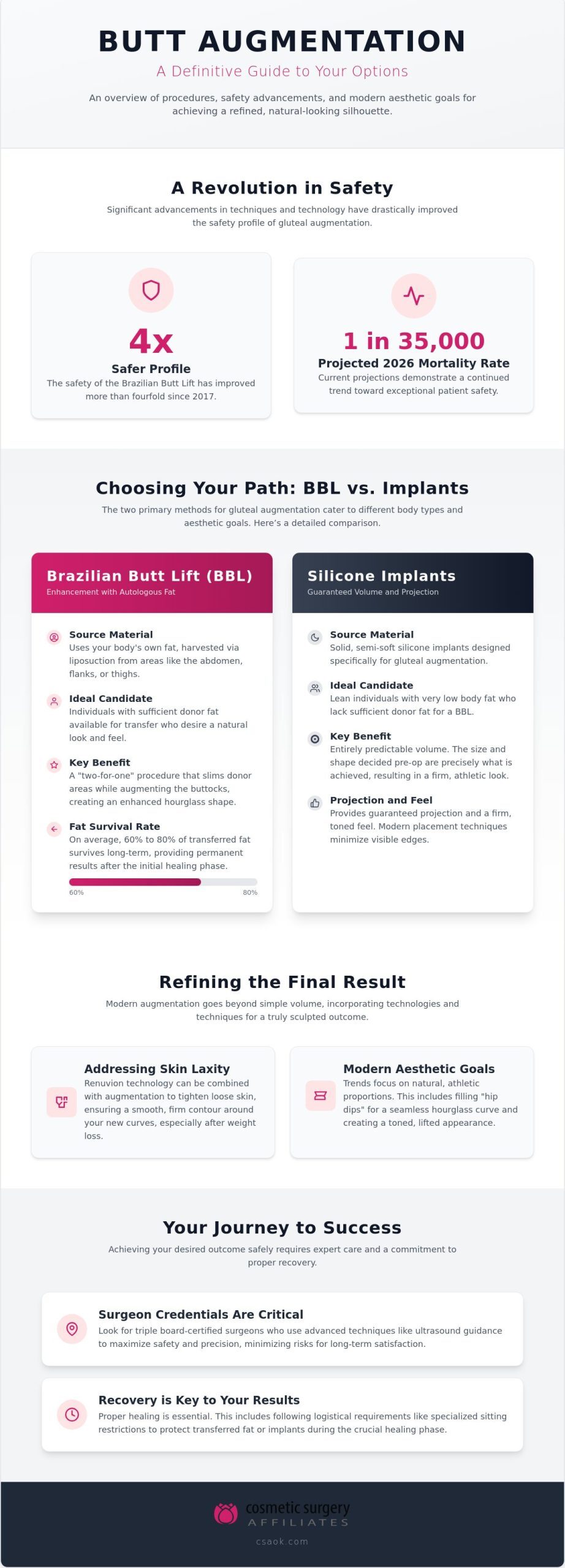
Did you know that the safety profile of the Brazilian Butt Lift has improved more than fourfold since 2017, with current 2026 projections placing the mortality rate as low as 1 in 35,000? It’s natural to feel hesitant about butt augmentation surgery when faced with conflicting headlines or viral safety warnings. You deserve a figure that feels balanced and fills out your clothing with confidence, but you shouldn’t have to sacrifice peace of mind for aesthetic results. Professional contouring is about more than just volume; it’s about achieving a refined, symmetrical restoration that looks and feels like you.
This guide provides a definitive comparison between fat transfer and implants to help you determine which procedure aligns with your anatomy and goals. You’ll learn how triple board-certified surgeons utilize ultrasound-guided techniques to maximize safety and why fat survival rates now average between 60% and 80%. We’ll also examine how advanced technologies like Renuvion address loose skin after weight loss, ensuring your transformation is as smooth as it is impactful. By the end, you’ll have a clear understanding of the surgical journey and the expertise required to achieve a safe, hourglass result.
Key Takeaways
- Distinguish between adding volume and lifting tissue to ensure your procedure addresses your specific concerns regarding projection or sagging.
- Evaluate the differences between autologous fat transfer and silicone implants to see which butt augmentation surgery provides your desired hourglass profile.
- Explore how combining augmentation with Renuvion skin tightening creates a more sculpted look by firming the skin around your new contours.
- Identify the critical safety standards and surgeon credentials that minimize risks while maximizing your long-term satisfaction and peace of mind.
- Understand the logistical requirements of recovery, including specialized sitting restrictions, to safeguard your newly transferred fat or implants during the healing phase.
What is Butt Augmentation Surgery? Understanding Your Options
Buttock augmentation is a sophisticated suite of surgical procedures designed to enhance the volume, shape, and contour of the gluteal region. While often associated with a single “look,” modern butt augmentation surgery is highly personalized. It addresses specific anatomical concerns such as a lack of projection, asymmetry, or loss of volume due to aging. This process is about more than physical change; it’s a transformative journey toward body symmetry. Achieving a balanced silhouette often leads to a profound restoration of self-confidence. It allows you to feel more comfortable in your own skin and find a better fit in your favorite clothing.
Gluteal Augmentation vs. Gluteal Lift
Understanding the difference between volume and position is crucial for a successful outcome. Augmentation adds substance to the glutes to create projection or fill in hollow areas. A lift, conversely, focuses on repositioning existing tissue that has shifted downward due to gravity or weight loss. If you have significant ptosis, which is the medical term for sagging, adding volume alone won’t solve the problem. In fact, adding weight to loose skin can make the sagging more prominent. For patients with excess skin, a combined procedure is often the gold standard. This allows your surgeon to target the “shelf” at the top of the glutes while refining the “projection” for a youthful, lifted appearance.
Common Aesthetic Goals in 2026
The aesthetic landscape of 2026 prioritizes refinement over exaggeration. The trend has moved away from oversized results toward natural, athletic proportions that complement your existing frame. Many individuals now focus on correcting hip dips or lateral hollows. These are the indentations on the sides of the hips that can disrupt a smooth silhouette. By filling these areas, surgeons create a seamless, hourglass curve. There is also a growing interest in the “athletic” gluteal shape. This technique emphasizes a toned, firm appearance that mimics the results of dedicated strength training. It’s a sophisticated approach that values precision and anatomical harmony. Whether you desire a subtle enhancement or a more curvaceous profile, the goal is always a result that feels authentic to your body.
BBL vs. Butt Implants: A Detailed Comparison
The choice between autologous fat and synthetic implants is the most significant decision you’ll make when planning your butt augmentation surgery. While both methods effectively increase volume, they cater to different physical profiles and aesthetic desires. Buttock enhancement procedures have evolved to offer highly predictable outcomes, but the most effective option depends entirely on your existing anatomy and the amount of donor fat available for harvest. If you are leaning toward a more natural approach, exploring the details of fat transfer surgery can help you visualize the potential for total body refinement.
The Brazilian Butt Lift (BBL) Advantage
A BBL utilizes your own tissue to enhance your curves. This creates a “two-for-one” benefit because your surgeon performs liposuction on donor areas like the abdomen, flanks, or thighs to harvest the fat. This process doesn’t just add volume to the glutes; it simultaneously slims the waistline to enhance your overall hourglass ratio. Because fat is a liquid medium, it allows for precise sculpting. Your surgeon can strategically place injections to fill hip dips or refine the upper gluteal shelf. Once the transferred fat establishes a blood supply, it feels and moves naturally. Research indicates that typically 60% to 80% of the transferred fat survives long-term, making the results permanent once the initial healing phase is complete.
When Silicone Implants are the Superior Choice
Silicone gluteal implants are often the gold standard for patients with very low body fat. If you’re a lean individual without sufficient donor fat for a BBL, implants provide a reliable way to achieve projection without requiring you to gain weight. Unlike fat transfer, the volume from an implant is entirely predictable. What you see during the surgical planning is exactly what you will achieve. Surgeons typically use intramuscular or subfascial placement planes to ensure the implant is well-supported by your own tissue. This technical precision prevents the visible edges sometimes associated with older techniques, resulting in a firm and athletic appearance.
- Material: BBL uses your own processed fat; implants use solid, semi-textured silicone.
- Contouring: BBL slims donor sites via liposuction; implants focus solely on gluteal projection.
- Feel: Fat transfer offers a softer, more natural movement; implants provide a firmer, consistent shape.
- Predictability: Implants offer a fixed, guaranteed volume; BBL results depend on the percentage of fat that survives the transfer.
Addressing Skin Laxity: The Role of Renuvion and Lifting
Achieving a refined gluteal profile requires more than just adding volume. If the skin is stretched or lacks elasticity, simply adding fat or implants can create a heavy, unnatural appearance. This is a common concern for patients who have experienced weight fluctuations or the natural effects of aging. A successful butt augmentation surgery must account for the canvas as much as the content. When skin laxity is present, we often integrate advanced technologies or traditional lifting techniques to ensure the new volume is properly supported and displayed.
In the evolving landscape of aesthetic medicine, the American Society of Plastic Surgeons on buttock enhancement highlights how combining procedures often leads to superior patient outcomes. For those with mild-to-moderate sagging, Renuvion skin tightening has become a transformative adjunct. However, for patients with more significant tissue redundancy following massive weight loss, excess skin removal surgery remains the most effective way to restore a firm, youthful foundation. Addressing these structural needs ensures your results look as athletic and toned as they feel.
Combining Liposuction and Renuvion
Renuvion utilizes cold helium plasma and radiofrequency energy to contract the subcutaneous tissues from within. When performed alongside liposuction, this technology allows for a “shrink-wrap” effect on the skin. It’s an ideal solution for patients who want to avoid the long incisions of a traditional lift but need more than just volume. This combination is particularly effective at defining the gluteal fold and tightening the skin around the lower buttocks and upper thighs. It provides a level of precision that was previously difficult to achieve with surgical volume alone.
The Traditional Buttock Lift
For patients with severe ptosis or sagging, a surgical lift is often the only way to achieve a balanced silhouette. This procedure focuses on removing a crescent of excess skin and tissue, effectively “pulling” the remaining skin upward. It’s the primary method for eliminating “banana rolls” and sagging that obscures the natural curve of the glutes. We take great care to place incisions strategically so they remain hidden within the bikini line or natural skin folds. While more invasive than plasma-based treatments, a lift is essential for creating a smooth, taut appearance after significant weight loss.
Safety First: Why Your Surgeon’s Credentials Matter
Safety is the cornerstone of every successful transformation. While butt augmentation surgery has become increasingly popular, the technical complexity of these procedures requires a master’s touch. The historical risks associated with fat transfer, specifically fat embolism, were largely due to injections being placed too deeply into or beneath the gluteal muscle. Modern safety protocols established in 2022 have revolutionized the procedure, mandating subcutaneous-only fat grafting. By using intraoperative ultrasound guidance, surgeons can now visualize the exact placement of fat in real-time, ensuring it remains in the safe zone above the muscle. This precision has led to 2026 mortality rate projections as low as 1 in 35,000, a massive improvement from the 1 in 3,448 rate seen in 2017.
Understanding Triple Board Certification
The title of “cosmetic surgeon” is often used loosely, but it’s not synonymous with being a board-certified plastic surgeon. A triple board certified plastic surgeon has undergone rigorous, multi-specialty training that far exceeds the minimum requirements for medical practice. This elite status reflects a deep commitment to surgical excellence and patient safety across various anatomical disciplines. This level of expertise ensures that your surgeon possesses the refined aesthetic judgment needed to create symmetry while maintaining the highest clinical standards. Choosing a surgeon with these credentials means you’re partnering with a specialist who prioritizes your health as much as your results.
The Consultation: Screening for Candidacy
A safe experience begins long before you enter the operating room. During your consultation, we conduct a thorough medical screening to ensure you’re a fit candidate for surgery. Certain health factors can influence your recovery and the “survival” rate of transferred fat, which typically ranges from 60% to 80% in 2026. We prioritize transparency regarding several key health markers:
- Body Mass Index (BMI): Maintaining a healthy BMI ensures safer anesthesia and better contouring results.
- Nicotine Use: Smoking severely restricts blood flow, which is critical for fat graft survival and wound healing.
- Heart and Lung Health: We verify your cardiovascular fitness to ensure a stable experience in an accredited surgical facility.
Personalized surgical plans are essential for long-term satisfaction. We reject “cookie-cutter” trends in favor of a tailored approach that respects your unique anatomy. Accreditation also plays a vital role; performing surgery in a facility that meets the highest standards for equipment and staffing ensures that every aspect of your care is managed by professionals. If you’re ready to discuss your goals for butt augmentation surgery with an elite surgical team, we invite you to schedule a consultation with our triple board-certified experts today.
Recovery and Long-Term Results: What to Expect
The success of your butt augmentation surgery depends heavily on the care you provide during the healing phase. While the surgical procedure creates the foundation, your adherence to post-operative protocols determines how well those results settle and last. Recovery is a methodical process that requires patience, especially during the first few weeks when the body is most reactive to the changes. You’ll need to prepare for a lifestyle shift that prioritizes tissue protection over convenience. This commitment ensures that your new contours remain symmetrical and vibrant for years to come.
Sitting directly on your glutes is strictly prohibited for the first 2 to 3 weeks. This restriction ensures that the delicate blood vessels can successfully nourish the newly transferred fat cells, which is essential for achieving the 60% to 80% survival rate typical of modern procedures. For implant patients, avoiding direct pressure prevents the silicone from shifting out of its surgical pocket. Most patients return to light desk work after 14 days, provided they use specialized cushions, while full physical activity and traditional sleeping positions usually resume after 8 weeks.
Specialized BBL and Implant Recovery Gear
To navigate the “no sitting” rule, you’ll utilize a BBL pillow. This device offloads your weight onto your thighs, allowing you to sit when necessary without compressing the gluteal region. We also emphasize the importance of professional lymphatic massage. These sessions reduce edema and prevent the formation of hard scar tissue, known as fibrosis, which can distort your final shape. You’ll also wear medical-grade compression garments for 6 to 8 weeks. These garments provide the necessary pressure to help your skin contract smoothly over your new curves and minimize post-operative swelling.
The Final Reveal: When is your ‘Final’ Result?
It’s natural to feel eager to see your transformation, but the initial look immediately after surgery is often influenced by significant swelling. You might feel your results look “over-filled” at first. As the swelling subsides over 3 to 6 months, the “fluffing” phase begins. This is when the skin relaxes and the transferred fat or implants settle into a more natural, soft position. Your long-term shape is also influenced by your lifestyle. Because transferred fat behaves like natural tissue, significant weight fluctuations can cause those cells to expand or shrink. Maintaining a stable weight is the best way to preserve your hourglass silhouette.
Every individual heals at a different pace, and your journey deserves expert oversight from start to finish. If you’re ready for a personalized assessment of your goals, schedule your consultation with our triple board-certified experts today to begin your transformation with confidence.
Your Path to a Balanced and Refined Silhouette
Choosing the right path for your body requires a balance of clinical expertise and artistic vision. Whether you opt for the natural sculpting of a Brazilian Butt Lift or the predictable projection of silicone implants, the goal remains a harmonious and symmetrical profile. Modern advancements, such as the integration of advanced Renuvion technology, allow us to address skin laxity with a precision that was previously unattainable. This ensures your results aren’t just voluminous but firm and well-defined.
Safety remains the most critical component of your journey. By prioritizing ultrasound-guided techniques and the oversight of national leaders in body contouring, you’ll move forward with peace of mind. Every butt augmentation surgery we perform is a personalized medical event designed to restore your confidence and renew your silhouette. Our triple board-certified expertise ensures that your transformation is handled with the highest level of surgical precision.
When you’re ready to take the next step toward your aesthetic goals, our team is here to provide the expert guidance you deserve. Schedule Your Consultation with a Triple Board-Certified Surgeon today to discover which approach aligns with your unique anatomy. We’re excited to help you achieve the natural-looking results you’ve been envisioning.
Frequently Asked Questions
Is butt augmentation surgery safe?
Yes, modern butt augmentation surgery is significantly safer today due to standardized protocols and advanced technology. Current 2026 projections place the BBL mortality rate between 1 in 25,000 and 1 in 35,000 when performed by board-certified specialists. Safety is maintained through subcutaneous-only fat grafting and the use of intraoperative ultrasound guidance. These methods ensure that fat is never injected into the muscle, virtually eliminating the risk of fat embolism.
How long do butt implants last compared to a BBL?
Silicone gluteal implants are designed to be permanent, though they carry a complication rate of approximately 20.6% that may require future revision. In contrast, BBL results are permanent once the transferred fat establishes a blood supply. Typically, 60% to 80% of the fat survives long-term. While implants provide a fixed volume, fat transfer results can change if your overall body weight fluctuates significantly after the procedure.
Can I sit down after a Brazilian Butt Lift?
You must avoid sitting directly on your buttocks for at least 2 to 3 weeks following a BBL. Direct pressure can compress the newly transferred fat cells, cutting off their blood supply and preventing them from establishing themselves. After this initial period, you’ll use a specialized BBL pillow to offload pressure onto your thighs. Following these restrictions is critical for ensuring the highest possible fat survival rate.
What is the difference between a butt lift and butt augmentation?
A butt lift focuses on removing excess skin and repositioning tissue to correct sagging, while augmentation focuses on increasing volume and projection. Augmentation uses either silicone implants or fat transfer to change the shape and size of the glutes. Many patients with significant skin laxity benefit from a combined approach. This addresses both the lack of volume and the physical descent of the tissue for a comprehensive restoration.
How much fat is needed for a BBL?
The amount of fat required varies based on your anatomy, but most surgeons harvest between 800cc and 1,500cc of fat to yield enough purified material for injection. Because only 60% to 80% of the fat typically survives, your surgeon will slightly overfill the area. Patients must have adequate donor sites, such as the abdomen, flanks, or thighs, to provide enough autologous tissue for a balanced enhancement.
Will my butt augmentation results look natural?
Natural-looking results are achieved by prioritizing body symmetry and choosing the right technique for your frame. Fat transfer offers the most natural feel and movement since it uses your own tissue. If you choose implants, your surgeon will use intramuscular or subfascial placement to ensure the edges are well-concealed. Modern techniques in 2026 emphasize refined, athletic proportions rather than the over-augmented looks of the past.
What happens if I lose weight after butt augmentation surgery?
Weight loss after butt augmentation surgery will cause transferred fat cells to shrink, just like fat in any other part of your body. This can lead to a reduction in the overall volume and projection of your results. If you have implants, the volume of the silicone remains constant, but the surrounding natural tissue may thin. We recommend reaching a stable goal weight before undergoing any contouring procedure.
How do I choose between implants and fat transfer?
The choice depends primarily on your body mass index and your available donor fat. If you are very lean and lack sufficient fat for liposuction, silicone implants are the superior choice for providing predictable volume. If you have donor fat available, a BBL is often preferred because it allows for total body contouring through liposuction of the waist or thighs. A consultation with a specialized surgeon is necessary for a final determination.