
You have reached your health goals, yet every profile photo reveals a receding chin and a lack of jawline definition that doesn’t reflect your vitality. It is common to feel that your features are out of proportion, perhaps making your nose appear larger than it is or creating the illusion of a double chin despite being at a healthy weight. You aren’t alone in wanting a facial structure that feels balanced, intentional, and strong.
Modern chin augmentation offers a sophisticated path to restoring facial symmetry and refining your profile through expert surgical precision. This guide explores how permanent structural enhancements can redefine your jawline and harmonize your entire appearance. You’ll learn why this procedure remains the strategic anchor for facial restoration. We will walk you through the latest 2026 techniques, the clinical reality of recovery, and the transformative impact this refinement has on both social and professional confidence.
Key Takeaways
- Understand how mentoplasty addresses a receding profile to improve the perceived proportions of your nose and neck.
- Evaluate the benefits of permanent surgical implants versus temporary dermal fillers to determine the best path for your aesthetic journey.
- Learn about modern chin augmentation techniques, including strategic incision placement, designed to create a natural and seamless jawline.
- Discover how combining profile refinement with complementary procedures can optimize the cervicomental angle for a more defined appearance.
- Recognize why triple board certification is the gold standard for ensuring surgical precision and patient safety in facial reconstruction.
What is Chin Augmentation? Defining Facial Balance
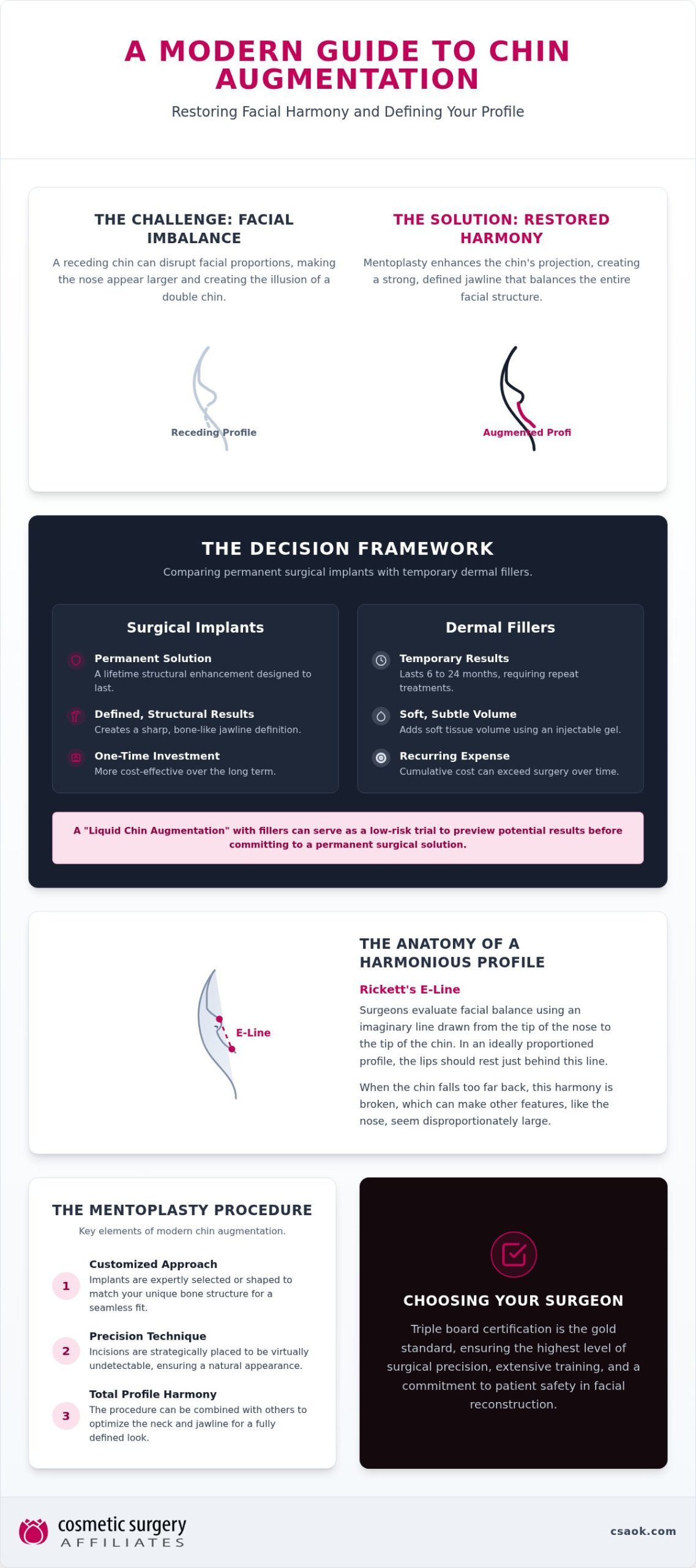
Facial harmony relies on the subtle relationship between every feature. When one element lacks projection, the entire structure feels misaligned. Many individuals focus on the size of their nose or the appearance of a double chin without realizing the underlying cause is often a receding chin. Mentoplasty, or chin augmentation, serves as a corrective measure to restore this essential equilibrium. By strategically enhancing the chin’s projection, surgeons can transform a profile from hesitant to assertive, creating a foundation for total facial rejuvenation.
To explore the clinical definition of What is Chin Augmentation?, we view it as a specialized surgical intervention that reshapes the lower face by placing an implant or repositioning the bone. This isn’t merely about adding volume; it’s about precision refinement. A “weak chin” often creates a visual illusion where the nose appears disproportionately large or the neck lacks a crisp, defined border. This lack of projection can make the jawline appear to melt into the neck, often resulting in a “double chin” appearance even when a patient is at an ideal weight. Correcting this deficiency provides a significant psychological boost. Patients frequently report improved self-assurance in social and professional settings once their external appearance matches their internal sense of self.
The Anatomy of a Harmonious Profile
Surgeons evaluate facial balance by looking at the relationship between the forehead, nose, and chin. One common standard used is Rickett’s E-line, which is an imaginary line drawn from the tip of the nose to the tip of the chin. In an ideal profile, the lips should sit just behind this line. If the chin falls too far back, the harmony is broken. This aesthetic depends on both the underlying bone structure of the mandible and the thickness of the overlying soft tissue. Precision in chin augmentation requires a deep understanding of how these layers interact. A surgeon must consider how the skin will drape over a new implant to ensure the result looks natural rather than artificial.
Functional vs. Aesthetic Mentoplasty
The majority of these procedures are performed for aesthetic refinement, focusing on the visual contour of the face. However, some cases involve functional issues where the jaw’s alignment affects the bite or speech. In these instances, a patient might need to consult both a surgeon and an orthodontist to ensure both form and function are addressed. Mentoplasty is the surgical refinement of the chin’s projection and shape. While fillers offer a temporary change, surgical intervention provides a permanent structural solution that matures gracefully with the patient. This procedure serves as a foundational step for those seeking a more balanced, symmetrical facial structure.
Surgical Implants vs. Dermal Fillers: The Decision Framework
Deciding between a permanent surgical enhancement and a temporary injectable requires a clear understanding of your long-term goals. While both options aim to improve facial proportions, they serve different purposes in a patient’s aesthetic journey. Surgical chin augmentation provides a permanent, structural change to the mandible, whereas dermal fillers offer a soft-tissue volume increase that requires ongoing maintenance. Many patients begin with a “Liquid Chin Augmentation” as a low-risk trial to preview their potential results before committing to a more definitive solution.
The choice often comes down to the degree of correction required and the desire for a lasting result. According to a clinical overview of chin augmentation, alloplastic implants are the gold standard for creating significant projection and defining the jawline. While fillers typically last between six months and two years, an implant is designed to last a lifetime. Over several years, the cumulative cost of repeated injections often surpasses the one-time investment of a surgical procedure, making surgery the more cost-effective choice for those seeking permanent refinement.
The Case for Chin Implants
Surgical implants are crafted from biocompatible materials, such as solid medical-grade silicone or porous polyethylene. These materials are chosen for their safety and ability to integrate seamlessly with your natural anatomy. A primary advantage of surgery is customization. Your surgeon can select or shape an implant to match your unique bone structure, ensuring the enhancement looks and feels natural. Once placed, these implants are remarkably stable. They provide a firm, bone-like feel that fillers, which are essentially gels, cannot replicate. This structural integrity is essential for creating the sharp, athletic jawline many patients desire.
Understanding Non-Surgical Limitations
Fillers are excellent for minor refinements or for patients who aren’t ready for a surgical recovery period. However, they have distinct physical limits. Over-injecting the chin to achieve significant projection can lead to “filler fatigue,” where the soft tissue becomes stretched or the product migrates away from the target area. If you find yourself in the following situations, it may be time to consider a permanent solution:
- You’re scheduling filler touch-ups more than once a year to maintain your profile.
- The volume of filler required is causing the chin to look “soft” rather than defined.
- You want a structural change that addresses the underlying bone deficiency.
- You’re ready for a one-time recovery period followed by permanent results.
Evaluating these factors with a specialist ensures you choose the path that best aligns with your lifestyle and aesthetic vision. You can explore our personalized approach to facial balance to see which technique is right for you.
The Mentoplasty Procedure: Techniques and Recovery
Mentoplasty requires an expert hand to ensure the implant integrates seamlessly with your natural jawline. The procedure is typically performed in an accredited surgical suite, taking roughly 45 to 90 minutes to complete. Most patients undergo the surgery under general anesthesia or local anesthesia with deep sedation to ensure absolute comfort throughout the process. This surgical intervention is designed to be efficient, allowing you to begin your recovery in the comfort of your own home on the same day.
Creating the implant pocket is a critical step that dictates the final aesthetic outcome. The surgeon makes a precise space directly against the mandibular bone, ensuring the implant remains stable and mimics the natural feel of your anatomy. This level of precision is vital for protecting the mental nerve, which provides sensation to the lower lip and chin. Choosing a surgeon with deep anatomical knowledge is the most effective way to minimize risks and ensure that your chin augmentation results are perfectly symmetrical.
Surgical Incision Strategies
The choice of incision site depends on your unique anatomy and aesthetic goals. An intraoral approach involves an incision inside the mouth, along the lower gum line. This method offers the benefit of zero visible scarring, though it requires diligent oral hygiene during the initial healing phase to prevent infection. Alternatively, the submental approach utilizes a small incision in the natural crease beneath the chin. This technique provides the surgeon with superior visibility and carries a lower risk of bacterial exposure, though it leaves a tiny, well-concealed scar that typically fades significantly over time.
The Recovery Journey
Patience is essential as your body adapts to its refined proportions. In the first 48 hours, you should expect moderate swelling and bruising around the jawline and neck. Your surgeon may recommend a liquid or soft-food diet during this time to minimize strain on the incision site. Most patients feel comfortable enough to return to their professional responsibilities within five to ten days, once the initial swelling begins to subside.
While you can resume light walking almost immediately, you must avoid strenuous exercise and heavy lifting for at least four to six weeks to protect the healing tissues. It is important to remember that chin augmentation results take time to fully mature. While the improvement in your profile is visible almost immediately, it can take up to six months for the final “settled” results to emerge as the last remnants of internal swelling dissipate. This gradual refinement leads to a permanent, natural-looking enhancement that balances your entire face.
Achieving Total Profile Harmony: Complementary Procedures
A refined chin is often the anchor of a balanced face, yet it rarely works in isolation. Achieving a truly harmonious profile requires a holistic perspective that considers how the lower face interacts with the nose and neck. During a comprehensive consultation, we evaluate your facial structure as a complete system. This approach ensures that your chin augmentation doesn’t just enhance one feature, but restores balance to your entire appearance. By addressing multiple areas simultaneously, we can optimize the cervicomental angle, which is the transition between the chin and the neck.
Lower face rejuvenation often involves more than just structural support. For patients experiencing significant tissue descent or volume loss, combining mentoplasty with a facelift provides a comprehensive solution. This combination addresses both the underlying bone deficiency and the skin laxity that occurs with age. The result is a more youthful, defined contour that looks entirely natural because it treats the face as a single unit rather than a collection of parts.
Mentoplasty and Rhinoplasty (Profileplasty)
The relationship between the nose and the chin is a critical factor in profile aesthetics. A small or receding chin can make a normally proportioned nose appear much larger than it is. Conversely, an overly prominent nose can overshadow a well-defined chin. Performing these procedures together allows for a dramatic shift in facial ratios. Profileplasty is the combined refinement of the nose and chin to achieve ideal facial ratios. This integrated approach ensures that every feature is in proportion, creating a profile that is balanced from every angle.
Defining the Jawline: Submental Liposuction and Renuvion
Structural enhancement via an implant is most effective when paired with soft tissue contouring. If there is excess fat beneath the jaw, submental liposuction can remove those stubborn deposits to reveal the new contours of the implant. For those with mild skin laxity in the neck, we often incorporate Renuvion skin tightening to firm the tissues. This combination creates the “chiselled” look that many patients desire. By combining structural support with precise soft tissue refinement, we achieve a crisp, athletic transition from the chin to the neck. If you’re ready to see how these procedures can transform your profile, you can schedule a consultation with our experts to discuss your personalized plan.
Choosing Your Surgeon: Why Triple Board Certification Matters
The success of your profile refinement depends entirely on the expertise and artistic vision of your surgeon. While technical skill is required to place an implant, an artistic eye for proportion is what ensures the result looks natural and harmonious. Triple board certification represents the pinnacle of surgical training, indicating that a surgeon has met the rigorous standards of three distinct medical boards. This level of specialization is particularly vital for chin augmentation, as the procedure requires a deep understanding of facial skeletal anatomy, soft tissue dynamics, and aesthetic ratios.
A personalized consultation is the most important step in your journey. During this meeting, your surgeon should evaluate your unique bone structure and discuss the anatomical limitations that dictate your potential outcomes. It is essential to view a surgeon’s “before and after” gallery specifically for facial implants rather than general cosmetic work. This allows you to assess their ability to create symmetry and balance across a variety of different facial types. Choosing a master of the craft ensures that your enhancement is tailored to your specific needs rather than a one-size-fits-all approach.
What to Ask During Your Consultation
Preparation is key to a successful outcome. You should feel empowered to ask detailed questions about the surgeon’s experience with various implant materials and their preferred surgical techniques. Safety is paramount, so inquire about the specific surgical facility and the protocols in place to minimize risk. If you are considering full-face rejuvenation, you might also ask how a chin implant coordinates with brow lift surgery or eyelid surgery to achieve a refreshed appearance. Understanding the full scope of your options helps you make an informed decision about your care.
The Cosmetic Surgery Affiliates Difference
At Cosmetic Surgery Affiliates, we prioritize natural-looking results and patient safety above all else. Our approach to chin augmentation is rooted in the belief that every individual deserves a customized solution that reflects their personal aesthetic goals. We combine clinical authority with empathetic care, walking you through every step of the decision-making process. If you’re ready to restore your facial symmetry and improve your self-confidence, we invite you to take the next step. Contact us today to schedule your consultation and discover how expert precision can refine your profile for a lifetime.
Restore Your Profile and Confidence
Your profile serves as the visual anchor of your face. Restoring its balance is more than a clinical procedure; it’s a restoration of your self-assurance. We’ve explored how chin augmentation provides the structural foundation necessary to harmonize your features, refine your jawline, and create a permanent result that fillers simply can’t replicate. By treating facial balance as a complete system, you can achieve a look that feels both refreshed and entirely natural.
Our practice offers triple board-certified surgical expertise and a specialized focus on natural facial harmony. We perform every procedure in modern surgical facilities and provide personalized recovery plans tailored to your unique journey. This commitment to precision and safety ensures that your transformation is handled with the highest level of professional care. You don’t have to live with a profile that doesn’t reflect your inner vitality.
Schedule your personalized chin augmentation consultation with our expert surgeons today. We’re ready to help you achieve the symmetry and refinement you’ve been seeking.
Common Questions About Chin Augmentation
Is chin augmentation surgery painful?
Discomfort is generally well-managed and temporary. Patients are usually under general anesthesia or deep sedation, so they feel nothing during the actual surgery. Afterward, you may experience a sensation of tightness or pressure as the tissues adapt to the new implant. Most individuals find that prescribed medication effectively controls this. Cold compresses also help reduce swelling and soothe the area during the first few days of your recovery journey.
How long do chin implants last?
Chin implants are permanent structural devices intended to last a lifetime. These implants are made from biocompatible materials like solid silicone, which the body doesn’t absorb or break down over time. Unlike temporary dermal fillers that require biennial maintenance, a surgical implant provides a one-time solution for profile refinement. While the implant itself is permanent, your face will continue to age naturally around the new structure.
Will I have a visible scar after mentoplasty?
Visibility of scarring depends on the surgical technique chosen for your procedure. An intraoral incision is made inside the lower lip, leaving no external evidence of surgery. If a submental approach is used, a small incision is placed in the natural shadow under your chin. This fine line typically heals into a very discreet mark that’s difficult to notice even upon close inspection as it matures over time.
Can a chin implant fix a double chin?
An implant can effectively reduce the appearance of a double chin when the cause is a receding jawbone. By increasing the chin’s projection, the implant pulls the submental skin forward, creating a sharper transition between the jaw and neck. If the concern is primarily due to excess adipose tissue, your surgeon might recommend combining chin augmentation with liposuction to achieve a truly contoured and athletic jawline.
What is the difference between mentoplasty and genioplasty?
Mentoplasty typically refers to enhancing the chin using an alloplastic implant, whereas genioplasty involves surgically repositioning the chin bone itself. Mentoplasty is often a simpler, faster procedure for most aesthetic concerns. Genioplasty is usually reserved for complex structural corrections or when the chin needs to be moved in multiple directions. Both techniques are effective forms of chin augmentation designed to restore facial balance and profile harmony.
How much does chin augmentation cost on average?
The total investment for this procedure depends on several factors, including the surgeon’s expertise, the surgical facility, and the specific type of implant required. Because every face is unique, we provide a detailed cost breakdown only after a thorough anatomical evaluation. This ensures that the estimate reflects your personalized surgical plan rather than a generic average. We recommend focusing on the long-term value of permanent results and surgical safety.
Can I combine a chin implant with a facelift?
Combining these two procedures is an excellent way to achieve comprehensive lower face rejuvenation. A facelift addresses sagging skin and jowls, while a chin implant provides the underlying structural support needed for a crisp jawline. This holistic approach ensures that the soft tissues are draped over a well-defined framework. Many patients choose this combination to achieve a more dramatic and youthful transformation in a single recovery period.
What happens if I decide I don’t like my chin implant later?
One of the benefits of using a surgical implant is that the procedure is technically reversible. If you are dissatisfied with the size or shape of your enhancement, the implant can be removed or exchanged during a secondary procedure. Our surgeons use advanced imaging and detailed consultations to ensure the chosen implant matches your aesthetic goals. This careful planning significantly reduces the likelihood that a patient will desire a revision.