

Most people assume the soft area that won’t budge after weight loss is just fat. Sometimes it is. Often it’s loose skin, and sometimes it’s both at once. That mix-up matters more than it sounds. Treat loose skin like it’s fat, and you can spend money on a procedure that leaves the area looking worse instead of better. Treat fat like it’s skin, and you’ve fixed nothing.
So before you book anything, it helps to know what you’re looking at. According to ISAPS, liposuction was the second most common cosmetic surgery worldwide in 2024, while non-surgical skin tightening was the fastest growing non-surgical treatment, up nearly 39 percent in a year. Two very different tools for two very different problems.
At Cosmetic Surgery Affiliates in Oklahoma City, our board-certified cosmetic surgeons spend a lot of time helping patients figure out which problem they’re really dealing with first. This article covers what loose skin and stubborn fat each are, how to tell them apart at home, and which treatments fit each one. We’ll also cover what to do when you have both.
Key takeaways
Short on time? Here’s the core of what this article covers about telling loose skin and stubborn fat apart.
- Loose skin and stubborn fat look alike but are different problems. Skin is the stretched covering that lost its bounce. Fat is the soft layer underneath, and the two often appear together.
- A quick at-home pinch and movement check gives strong clues. Thin, wrinkly tissue that flaps on its own points to skin. A thick, cushioned roll that springs back points to fat.
- Loose skin doesn’t respond to diet, exercise, or creams. Once the support fibers stretch out, surgical removal is the real fix. Non-surgical tightening can help mild cases.
- Stubborn fat responds well to liposuction when you’re near a stable weight. But lipo on skin that’s lost its elasticity can leave the area looser, not tighter.
- When you have both, combined procedures treat the skin and fat together. That’s why a professional evaluation is the most reliable way to pick the right plan.
What is loose skin, and why does it hang after weight loss?

Loose skin is exactly what it sounds like: skin that no longer snaps back against your body. To understand why it happens, it helps to know what keeps skin tight in the first place.
Your skin gets its firmness from two proteins, collagen and elastin. Think of them like the elastic in a waistband. Gaining weight stretches the skin to make room. Carry that weight long enough, and those fibers stretch past the point where they can fully bounce back.
When the weight comes off, the fat shrinks but the skin doesn’t always follow. That’s the soft, draped look no amount of effort seems to fix.
How fast you lose weight matters too. A 2024 study found that people who dropped weight quickly, such as after bariatric surgery, tended to have less elastic skin than those who lost it gradually. Age, genetics, and sun exposure chip away at collagen as well, so the same weight loss leaves very different results from person to person.
Pregnancy stretches skin in its own way, with rapid changes and hormonal shifts across the belly, breasts, hips, and thighs. It makes complete sense to feel frustrated when your body doesn’t bounce back the way you hoped.
Loose skin tends to settle in a few predictable places:
- The abdomen, which is usually the most noticeable area
- The upper arms
- The inner thighs
- The breasts and chest
- The neck and lower face
- The buttocks
Mild looseness can improve a little on its own over several months as your skin adjusts, particularly in younger skin that still produces plenty of collagen. Significant sagging is a different story, and that’s where understanding your fat comes in next.
What does stubborn fat actually look and feel like?
Stubborn fat is the soft layer that sits right under your skin, the kind you can grab with your hand. In medical terms it’s called subcutaneous fat, and it makes up the large majority of your body fat.
Unlike loose skin, fat has volume. It looks smooth and rounded, and it holds its shape instead of folding or hanging. Press on it and it feels thick and cushioned, almost like memory foam that springs back.
There’s a deeper kind too, called visceral fat, which wraps around the organs inside your abdomen. You can’t pinch that layer. The fat you can actually grab, the kind that frustrates you in the mirror, is almost always the subcutaneous kind.
Here’s the part that surprises people. Stubborn fat can persist even when your overall weight sits in a healthy range. A 2023 study found that about 26 percent of men and 38 percent of women whose weight fell in a healthy range still carried excess body fat.
Some fat deposits simply resist diet and exercise. Cells in areas like the lower belly, hips, and thighs hold on more tightly, based on how they respond to fat-burning signals. That’s not a willpower problem, it’s biology, shaped partly by genetics and hormones. Because fat behaves so differently from skin, telling them apart at home is genuinely useful.
How can you tell the difference between loose skin and fat at home?
You can get a good read on your own body with two simple checks: a pinch and a little movement. Neither replaces a professional opinion, but together they point you in the right direction.
Start with the pinch test. Gently grab the area between your thumb and finger. If what you’re holding feels thin and papery and wrinkles up between your fingers, that’s mostly skin. If it feels thick, dense, and cushioned, and it springs back when you let go, that’s mostly fat.
Then watch how the area moves. Loose skin tends to flap or shift on its own when you walk, jump, or shake the area, almost like it’s moving independently from the muscle underneath. Fat moves with you and feels more anchored.
The table below sums up the main differences at a glance.
| What you’re checking | Points to loose skin | Points to stubborn fat |
|---|---|---|
| Pinch feel | Thin, papery, wrinkles up | Thick, cushioned, springs back |
| Appearance | Crepey, folded, or hanging | Smooth, rounded, holds its shape |
| Movement | Flaps or shifts on its own | Moves with you, feels anchored |
| Body fat clue | Often shows at a lower body fat | Can persist at a healthy weight |
Here’s the catch. Loose skin and fat often live in the same spot, especially after weight loss or pregnancy. Most people aren’t a clean case of one or the other, and the pinch test has limits, since skin thickness and fat vary across the body.
That’s where a trained eye becomes worth it. A board-certified cosmetic surgeon can assess your skin, fat, and muscle in person and tell you what’s really going on. That saves you from guessing your way into the wrong procedure.
Katie, a patient who researched surgeons across Oklahoma and beyond before choosing this practice, shared her experience:
“Dr. Courtney Caplin is truly amazing and has so much talent! CSA was the third cosmetic surgery facility I received a consult from as I had done extensive research on procedures and doctors in the OKC area and out of state. The entire process was so simple, I shared my insecurities with my consultant…”
If you’ve been going back and forth trying to label your own problem area, a consultation clears it up fast. You can schedule a consultation with Cosmetic Surgery Affiliates and get a straight answer about what you’re working with. From there, the right treatment becomes a much clearer choice.
What are the right treatments for loose skin?
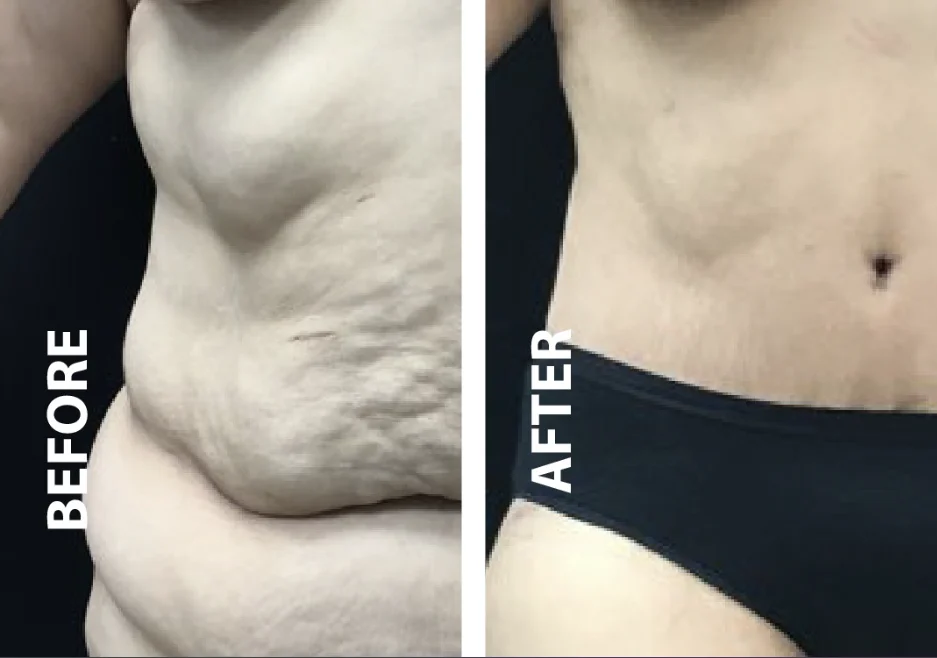
Loose skin needs to be removed or tightened, because no diet or workout puts elasticity back into fibers that are already stretched out. The right approach depends on how much loose skin you have and where it sits.
Surgical skin removal
For moderate to significant loose skin, surgical removal gives the most reliable result. Plastic surgery for the belly area known as a tummy tuck (abdominoplasty) trims hanging skin and tightens the muscles underneath. That’s especially helpful when the muscles have separated after pregnancy, a common issue called diastasis recti.
The same idea applies elsewhere. Cosmetic surgery for the arms addresses sagging upper arms, thigh lift plastic surgery recovery is straightforward for the inner thighs, and body lifts surgery handles several areas at once. Reviewing whether you’re one of the candidates for remove excess skin surgery helps clarify what your next step should be. Seeing real abdominoplasty before-and-after results can also help set realistic expectations.
Non-surgical skin tightening
If your skin laxity is mild, you may not need surgery at all. Energy-based treatments use radiofrequency or ultrasound to heat the deeper layers of skin and encourage it to firm up gradually over a few months.
Triple board-certified cosmetic surgeon Dr. Erik Nuveen often recommends a minimally invasive renuvion treatment for patients with minimal looseness, especially younger patients whose skin can still retract. These treatments work best for early, mild changes, not skin that already hangs or folds.
Creams and exercise
Creams and workouts have real limits worth knowing. Retinol can improve thin, crepey texture, but it can’t lift skin that truly hangs. Strength training builds muscle underneath, which fills the area out a little, but it doesn’t remove excess skin.
The recovery window
Recovery depends on the procedure and how extensive it is. After a tummy tuck, most patients wear a supportive binder for several weeks and ease back into work within two to four weeks. More strenuous activity returns gradually after that.
Following your surgeon’s aftercare plan closely protects your result and helps your skin settle smoothly. Swelling and soreness are a normal part of healing, and they fade over the following weeks. Once your skin is addressed, the next question is the fat that’s often tagging along.
What are the right treatments for stubborn fat?
Stubborn fat that resists diet and exercise responds to a different toolkit than loose skin. The goal here is to reduce volume, not to tighten a covering.
The case for liposuction
Liposuction is the most direct option for removing localized fat, and finding a skilled lipo surgeon matters most when the fat is your primary concern. Your surgeon uses a thin tube to gently suction out fat cells through tiny openings, sculpting areas like the belly, flanks, thighs, and arms.
It works best when a few things line up:
- You’re within roughly 10 percent of a stable goal weight
- You have firm, elastic skin that can shrink to your new shape
- The fat is localized and pinchable, not deep visceral fat
- You’re treating a specific area, not trying to lose overall weight
Non-surgical fat reduction and the role of medical weight loss
For smaller pockets of fat, non-surgical options exist, such as controlled cooling that targets fat cells. A 2023 review found these treatments trim a small but measurable amount, so they suit modest touch-ups rather than dramatic change.
If you’re not yet at a stable weight, that’s worth sorting out first. Some practices, including ours, offer medical solutions for stubborn body fat with GLP-1 medications like semaglutide and tirzepatide. They quiet hunger signals, making it easier to reach a steady weight before any contouring.
The mistake of treating loose skin with liposuction
This is the trap the whole article is built around. Removing fat from an area that’s actually loose skin takes away the volume filling the skin out, which can leave it looking even more deflated.
We know it’s frustrating that the simplest-sounding fix isn’t always right. The good news is that a careful evaluation prevents this mismatch, with a clear plan when you have both problems.
What if you have both loose skin and fat?
Most people who’ve lost a lot of weight or been through pregnancy fall into this camp, with some fat and some loose skin in the same area. Encouragingly, surgeons treat this combination every day.
For a broader look at fat removal surgery choices, our guide comparing fat removal surgery options for stomach and body walks through when each approach fits best
The most common approach pairs liposuction with skin removal in a single surgery. When liposuction and a tummy tuck are done together, it’s called a lipoabdominoplasty. It removes the fat while tightening and trimming the skin in one operation. Mommy makeover procedures in okc follow the same logic, combining procedures to address the belly, breasts, and stubborn fat at once.
For the right candidate with mild laxity, minimally invasive radiofrequency can tighten skin while fat is removed, with less downtime. The right combination comes down to your anatomy, which the team at Cosmetic Surgery Affiliates maps out during a personalized consultation. They’ll also walk you through transparent pricing and flexible financing through PatientFi and Alphaeon.
The table below shows how the problem usually points to the solution.
| What you’re dealing with | Common approach |
|---|---|
| Mostly loose skin | Tummy tuck, arm, thigh, or body lift, or non-surgical tightening for mild cases |
| Mostly stubborn fat | Liposuction, or non-surgical fat reduction for small areas |
| Both skin and fat | Combined surgery like lipoabdominoplasty or a mommy makeover |
Understanding how to choose the best oklahoma city plastic surgeons for your goals is the piece that turns the right diagnosis into the right result.
Alta, a patient who had several procedures combined into one plan, shared her experience:
“I cannot say enough wonderful things about Dr. Tessa Meyer and the entire team at Cosmetic Surgery Affiliates. Dr. Meyer is a true artist — she understands the form, lines, and natural balance of the human body, and that expertise is evident in her results. I had a full lower body lift, breast lift,…”
Seeing how the pieces fit together is exactly what a consultation is for, the surest way to land on a plan built for your body.
Conclusion
Loose skin and stubborn fat can look like the same problem in the mirror, but they call for different solutions. Skin needs to be tightened or removed. Fat needs to be reduced. Once that clicks, the long list of procedures makes far more sense, and you’re less likely to pay for the wrong fix.
The most reliable way to know what you’re dealing with is an in-person look from someone who does this every day. At Cosmetic Surgery Affiliates in Oklahoma City, every patient deserves to feel heard, informed, and confident in their choice. When you’re ready, book your consultation and get a plan built around your body and your goals.
Frequently asked questions
Is my saggy belly loose skin or fat?
Try a gentle pinch. If the tissue feels thin and wrinkles up between your fingers, it’s likely loose skin, and if it feels thick and cushioned and springs back, it’s likely fat. Many people have a mix of both, so a quick evaluation with a board-certified cosmetic surgeon is the surest way to know.
Do loose skin and stubborn fat ever occur together?
Yes, and it’s extremely common, especially after major weight loss or pregnancy. The skin stretched to cover the extra volume and didn’t fully retract, while some stubborn fat stayed behind. This is exactly why combination treatments exist.
Will loose skin go away on its own without surgery?
Mild looseness can improve over three to twelve months after your weight stabilizes, especially in younger skin. Significant sagging that clearly hangs or folds generally won’t tighten on its own, because the support fibers are permanently stretched. At that point, surgical removal is the dependable fix.
Does CoolSculpting work on loose skin?
CoolSculpting is cleared to reduce fat, not to tighten skin. If your real issue is loose skin rather than fat, treatments that only remove fat can actually make the looseness more noticeable. That’s why identifying the true problem first matters so much.
How long after weight loss should I wait before considering skin removal surgery?
Most surgeons recommend holding a stable weight for at least six to twelve months first. Letting your weight settle protects your result, since further weight changes can alter the contour after surgery. A consultation is the right place to confirm your timing and readiness.
*Disclaimer: This content is for educational purposes only and does not constitute medical advice. A consultation with a qualified board-certified surgeon is required to determine the best treatment plan for your individual needs and any questions you may have about a medical condition or procedure.