Did you know that up to 97% of individuals who choose ear reshaping describe the results as life-changing and “worth it”? For many, the decision to pursue otoplasty ear surgery is rooted in a long-standing desire to finally stop hiding. You might have spent years using long hair or hats to mask prominent ears, or perhaps you’ve felt the persistent weight of social anxiety due to a lack of facial symmetry. It’s a significant emotional burden to carry, but it’s one that modern medical artistry can permanently resolve.
We believe that aesthetic refinement should look entirely natural and never appear “operated on.” In this comprehensive guide, you’ll discover how advanced techniques can reshape the auricular structure, restore balance to your profile, and provide a permanent boost to your self-confidence with minimal downtime. We will walk you through the differences between traditional ear pinning and modern cartilage-sparing methods, the specifics of the recovery timeline, and what you can realistically expect from this transformative procedure. By understanding the clinical precision behind the art of otoplasty, you can move forward with a clear, informed perspective on your path toward a more balanced appearance.
Key Takeaways
- Understand how otoplasty ear surgery addresses structural concerns like conchal excess to create a more balanced and proportionate ear shape.
- Learn about the advanced techniques used to achieve facial symmetry through discreet incisions and personalized surgical mapping.
- Determine your candidacy by reviewing the essential health criteria and psychological readiness required for optimal healing and satisfaction.
- Gain a clear understanding of the recovery roadmap, including the transition from initial dressings to a protective headband during the first week.
- Discover how specialized, board-certified expertise ensures a natural-looking result that prioritizes both precision and your personal aesthetic goals.
What is Otoplasty Ear Surgery? Defining Precision Ear Correction
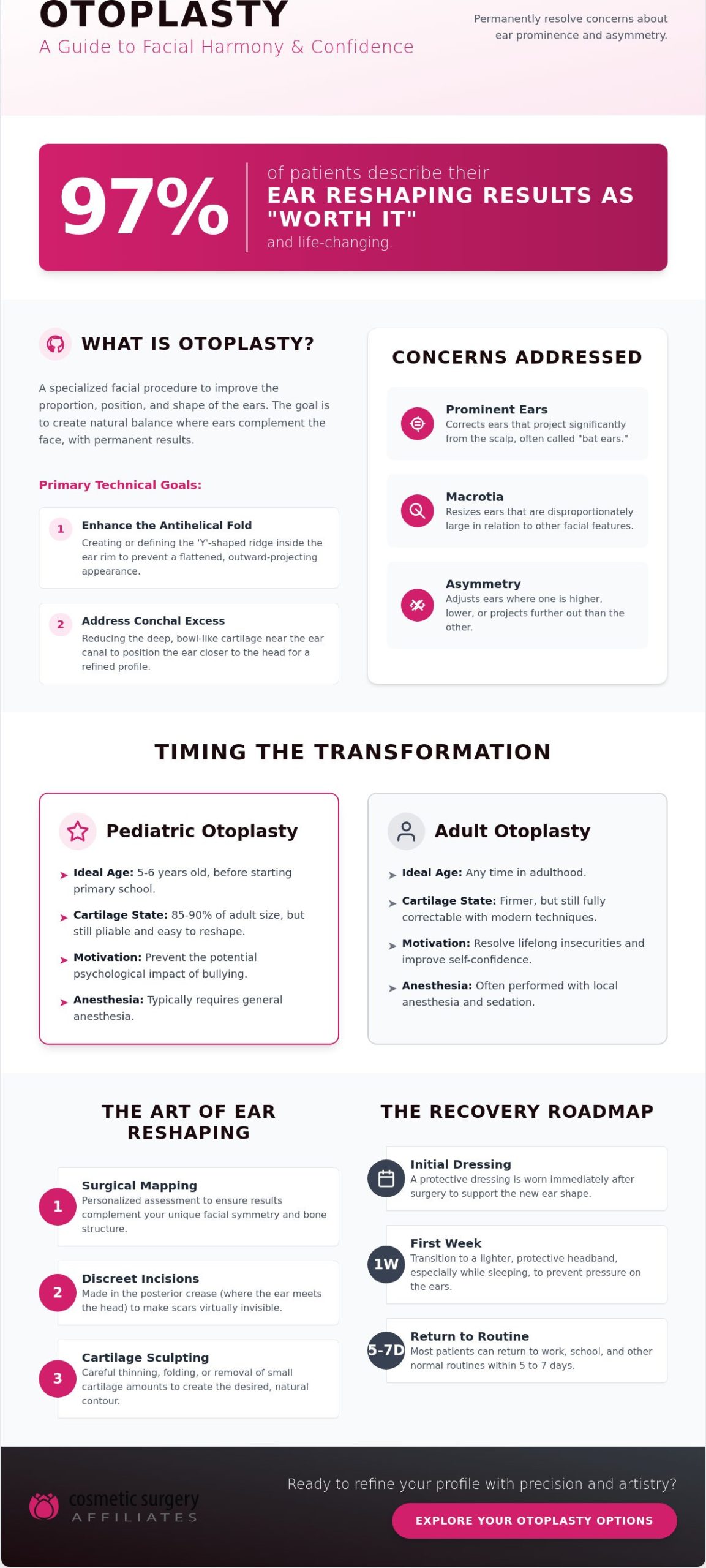
At its core, otoplasty ear surgery is a specialized facial procedure designed to improve the proportion, position, and shape of the ears. While often colloquially referred to as “ear pinning,” modern techniques represent a far more nuanced approach to facial harmony. The primary objective is to create a natural balance where the ears complement the face rather than distract from it. This surgical intervention involves the careful reshaping of the ear’s structural framework, ensuring that the results appear inherent to the patient’s anatomy.
The technical goals of Otoplasty typically focus on two specific anatomical features. First, surgeons work to create or enhance the antihelical fold, which is the Y-shaped ridge inside the rim of the ear. When this fold is absent, the ear appears to flatten and project outward. Second, the procedure addresses conchal excess, which is an overdevelopment of the deep, bowl-like cartilage near the ear canal. By reducing this excess, the ear can be positioned closer to the side of the head, achieving a more refined and less prominent profile.
It is helpful to distinguish between cosmetic otoplasty and reconstructive ear surgery. Cosmetic procedures focus on refining the existing structure for aesthetic balance. In contrast, reconstructive surgery addresses more complex issues such as congenital defects like microtia or structural damage resulting from traumatic injuries. Regardless of the primary motivation, the results of otoplasty ear surgery are typically permanent. Once the cartilage is reshaped and healed, it retains its new position, providing a lifetime of improved self-confidence.
Common Concerns Addressed by Otoplasty
Patients seek ear refinement for several distinct reasons. The most frequent concern involves prominent ears, often described as “bat ears,” which project significantly from the scalp. Another common issue is macrotia, a condition where the ears are disproportionately large in relation to the rest of the facial features. Many individuals also struggle with asymmetry, where one ear sits noticeably higher, lower, or further outward than its counterpart. Precision surgery allows for the correction of these irregularities to create a more uniform, symmetrical appearance.
Pediatric vs. Adult Otoplasty: Timing the Transformation
Timing is a critical factor in the success of the procedure. For pediatric patients, the “golden window” often occurs between the ages of 5 and 6. At this stage, the ear cartilage is sufficiently developed and has reached approximately 85% to 90% of its adult size, yet it remains pliable enough for easy reshaping. Correcting prominent ears before a child enters primary school can prevent the psychological impact of bullying. Just as establishing healthy habits with Fun Valley Kids Dental Group supports a child’s overall developmental wellness, otoplasty can be a vital part of building a foundation for long-term self-esteem. Adults, however, frequently seek refinement to resolve lifelong insecurities. While children often require general anesthesia for comfort and safety, many adults can undergo the procedure using local anesthesia with sedation. Recovery expectations remain similar for both groups, with most patients returning to their normal routines within five to seven days.
The Art of Ear Reshaping: Advanced Surgical Techniques and Customization
Modern otoplasty ear surgery is far more than a mechanical adjustment; it’s a precision-based art form that prioritizes structural restoration. The process begins with a detailed consultation where the surgeon maps out your facial symmetry. This mapping ensures that the ears will sit in a position that complements your unique bone structure and profile. By treating each ear as a distinct component of a greater whole, the surgeon can achieve a result that looks inherently natural rather than surgically altered. If you’re ready to refine your profile, exploring otoplasty options with an expert can provide the clarity you need.
To access the underlying framework, surgeons utilize discreet, well-hidden incisions typically located in the posterior crease where the ear meets the head. This strategic placement ensures that once healed, evidence of the procedure is virtually invisible. Through these small access points, the surgeon enters the “sculpting” phase. This involves thinning, folding, or occasionally removing small amounts of cartilage to achieve the desired contour. Every adjustment is made with extreme care to maintain the ear’s structural integrity while refining its outward appearance.
Once the new shape is achieved, internal, permanent sutures are used to secure the cartilage. These sutures act as an invisible scaffold, holding the ear in its refined position while the body heals around it. The Otoplasty procedure is highly customized, ensuring that the tension used is exactly right to avoid a “pulled back” look. This careful tension management is what distinguishes a masterfully executed surgery from a generic one.
Cartilage Sparing vs. Cartilage Scoring Techniques
The choice between cartilage-sparing and cartilage-scoring techniques depends on the thickness and flexibility of your ear’s framework. Cartilage-sparing methods involve folding the tissue with sutures to create a new antihelical fold without removing material. In contrast, cartilage scoring involves making precise, microscopic incisions to allow thicker cartilage to bend more easily. A skilled surgeon selects the method that provides the most stable, natural-looking result for your specific anatomy, preventing an “operated-on” appearance.
Achieving Natural-Looking Symmetry
Achieving 100% mathematical symmetry is rarely the goal, as natural faces possess inherent slight variations. Instead, the focus is on achieving a harmonious auriculo-cephalic angle, which is the distance and angle between the ear and the side of the head. Surgeons also pay close attention to the lobule, or earlobe, ensuring it follows the new line of the upper ear. This holistic approach prevents common deformities where the middle of the ear is pinned while the top or bottom continues to protrude.
Determining Candidacy: Is Ear Correction Surgery Right for You?
Identifying your suitability for otoplasty ear surgery requires a balanced look at your health, anatomy, and personal goals. For pediatric patients, the primary requirement is a stable ear size. This milestone is typically reached by age 5 or 6, when the ear has achieved nearly its full adult dimensions. Adults must be in good overall health and maintain a non-smoker status. Since smoking constricts blood vessels and hinders the delivery of oxygen to healing tissues, it’s essential to abstain for several weeks before and after the procedure to ensure optimal recovery.
Beyond the physical, psychological readiness is a cornerstone of a successful transformation. You should approach the procedure with a clear understanding of what it can achieve. The goal is to enhance facial balance and restore symmetry, rather than seeking a flawless ideal. When you have realistic expectations, the emotional reward of the procedure is significantly heightened, allowing for a permanent boost in self-image.
The Consultation: Your Roadmap to Results
The initial meeting is a collaborative process where your unique anatomy is measured against your aesthetic goals. You should bring a complete medical history and clear examples of the look you hope to achieve. During the physical exam, the surgeon assesses cartilage elasticity and skin quality to ensure the structural framework can support the desired changes. This is also when you will discuss anesthesia options. While children almost always require general anesthesia for a stress-free experience, many adults opt for local anesthesia with sedation, allowing for a comfortable and efficient procedure.
Addressing Objections: Scarring and Longevity
Many patients express concerns regarding the longevity of the results or potential scarring. Because incisions are tucked into the natural crease behind the ear, any resulting marks are virtually invisible to the naked eye. This strategic placement allows you to wear short hair or updos with total confidence. Another benefit is the “one-and-done” nature of the procedure. Unlike some cosmetic treatments that require maintenance, the results of otoplasty ear surgery are permanent and do not “wear off” as you age. It is also helpful to clarify that this surgery focuses exclusively on the external auricular structure. It does not affect the internal ear or impact your hearing in any way.
The Path to Transformation: A Detailed Recovery Roadmap
The success of otoplasty ear surgery depends heavily on the precision of your post-operative care. While the surgical phase involves structural changes, the recovery phase is where those changes are stabilized and refined. Most patients find the process manageable, provided they follow a structured timeline designed to protect the delicate cartilage as it sets into its new position. If you have questions about your specific healing timeline, you can schedule a follow-up consultation to ensure your progress is on track.
During the first 24 hours, your primary focus is rest and protection. You will wear a thick compression dressing that covers the ears entirely. This dressing is essential for minimizing the risk of a hematoma and ensuring the skin adheres properly to the newly shaped cartilage. Once this initial wrap is removed by your surgeon, you will transition into the next phase of healing. Between days 2 and 7, you will likely experience mild discomfort or a feeling of tightness. Most adults and children can return to work or school within 5 to 7 days, provided they avoid strenuous physical contact.
By weeks 2 through 4, you can gradually resume light activities and social engagements. While the ears will still be sensitive, the most visible signs of surgery, such as bruising, typically fade during this window. It’s important to remember that full maturation of the ear shape takes time. The final, subtle refinements of the ear’s contour and position usually become visible between 3 and 6 months post-surgery, once all residual deep-tissue swelling has completely subsided.
Post-Operative Care Essentials
Adhering to specific care instructions prevents complications and ensures the best aesthetic outcome. One of the most important tools is a soft, tennis-style headband. You must wear this during sleep for several weeks to prevent the ears from being pulled forward or folded accidentally while you turn in bed. Keeping the incision sites behind the ear clean is also vital for preventing infection and ensuring flat, discreet scarring. Additionally, you should avoid contact sports or any activity that puts the ears at risk of trauma for at least six weeks, as a sharp pull can disrupt internal sutures before the cartilage has fully hardened.
What to Expect: Sensation and Appearance
It’s common to experience temporary numbness or a “tingling” sensation as the local nerves begin to heal. This is a normal part of the regenerative process and typically resolves on its own. You might also notice that your ears appear “over-corrected” or too close to your head initially. This is almost always due to localized swelling and the tension of internal sutures. As the inflammation decreases, the ears will settle into their permanent, natural-looking position. If you notice excessive redness, persistent heat, or unusual discharge, contact your surgical team immediately to rule out any minor complications.
Elevating Facial Harmony: The Cosmetic Surgery Affiliates Approach
Choosing a provider for otoplasty ear surgery involves more than finding a surgeon; it requires finding a partner who understands the delicate relationship between form and function. At Cosmetic Surgery Affiliates, we approach every procedure with a focus on elevating facial harmony. We recognize that your ears are a key component of your overall profile, and our goal is to ensure that any refinement we perform enhances your natural beauty without drawing attention to the surgery itself. By prioritizing both safety and aesthetic precision, we provide a transformative experience that is grounded in medical excellence.
Our surgeons often integrate otoplasty into a broader facial rejuvenation strategy when requested by our adult patients. For instance, achieving a balanced profile might involve pairing ear refinement with a Chin Augmentation or a Facelift to ensure every feature is in proportion. Some patients also find that a descending brow line contributes to an aged or heavy upper face, and exploring brow lift surgery alongside ear refinement can create a more comprehensive and harmonious facial rejuvenation. This holistic view of facial anatomy allows us to create results that are seamless and sophisticated. We believe that every patient deserves a tailored plan that addresses their specific concerns while maintaining the integrity of their unique appearance.
In addition to surgical interventions, maintaining the skin’s vitality through advanced topical treatments is a cornerstone of lasting facial harmony. For those looking to optimize their skin health with ingredients like peptides and hyaluronic acid, skincareprogroup.com offers professional guidance on building an effective regimen.
Triple Board-Certified Surgical Precision
Triple board certification is a distinction that reflects a surgeon’s commitment to the highest standards of medical education, training, and ethics. For our patients, this means their care is overseen by an elite specialist who has demonstrated mastery across multiple surgical disciplines. When performing otoplasty ear surgery, this level of expertise is critical. The ear’s complex cartilage structure requires a surgeon who possesses both clinical precision and an artistic eye to achieve a result that looks inherent to the patient. The CSA philosophy is simple: we refine your features while honoring your unique look, ensuring that your results are as safe as they are beautiful.
Your Journey to Confidence Starts Here
The transformation following ear correction is often as much emotional as it is physical. We’ve seen firsthand how children regain their enthusiasm for social activities and how adults finally feel comfortable wearing their hair back after years of hiding behind hats or long styles. This journey is a collaborative one, and we prioritize open communication from the first meeting. We listen to your concerns, assess your anatomy, and provide a clear, medically grounded path toward your goals. If you’re ready to explore the possibilities of precision ear refinement, we’re here to guide you. Schedule your personalized otoplasty consultation today and take the first step toward a more confident, balanced version of yourself.
Empowering Your Transformation through Precision Ear Refinement
Choosing to undergo otoplasty ear surgery is a significant step toward aligning your physical appearance with your internal sense of confidence. As we have explored, modern techniques prioritize the preservation of your unique anatomy while correcting structural concerns like conchal excess or prominent positioning. This procedure is not just about “pinning” ears back. It is a sophisticated method of structural restoration that yields permanent, life-changing results for both children and adults alike.
At Cosmetic Surgery Affiliates, we combine specialized facial rejuvenation expertise with a meticulous focus on natural-looking symmetry. Our goal is to ensure your results feel like a natural extension of your profile. If you’re ready to move past the days of hiding behind hats or hair, our team is prepared to guide you through a personalized surgical plan tailored to your specific needs. Trusting your care to an elite surgical team ensures that your safety and aesthetic goals remain the highest priority.
Book Your Consultation with Our Triple Board-Certified Surgeons today to begin your journey toward a more balanced and refined appearance. We look forward to helping you achieve the lasting confidence you deserve.
Frequently Asked Questions
How much does otoplasty ear surgery cost on average?
The total investment for ear reshaping is determined by the specific anatomical corrections required and the surgical techniques employed. Fees typically encompass the surgeon’s expertise, the facility costs, and the materials used for post-operative care. Because every anatomical concern is unique, we provide a detailed cost breakdown during your private consultation to ensure transparency and help you plan your transformation with confidence.
Will otoplasty leave visible scars on my ears?
Incisions for this procedure are strategically placed in the natural posterior crease where the ear meets the head, making them virtually invisible. This strategic placement allows the skin to heal in a way that conceals any evidence of the surgery. Over time, these fine lines fade significantly and remain tucked away from view, even if you choose to wear your hair short or in an updo.
What is the best age for a child to have ear correction surgery?
Children are typically ideal candidates for this procedure between the ages of 5 and 6. By this time, the ear cartilage has reached approximately 85% to 90% of its adult size and is stable enough for precise reshaping. Addressing prominent ears before a child enters primary school can provide a permanent boost to their self-esteem and prevent potential social challenges related to their appearance.
How long do I need to take off work or school for otoplasty recovery?
Most patients can return to work or school within 5 to 7 days after otoplasty ear surgery. While the initial recovery is relatively quick, you’ll need to wear a protective headband during sleep for several weeks to safeguard the new ear position. You should plan to avoid strenuous physical activities or contact sports for at least six weeks to allow the cartilage to fully stabilize.
Can otoplasty fix ears that are different sizes?
Yes, otoplasty can effectively address asymmetry and ears that are disproportionate in size or shape. Surgeons can reduce the size of a larger ear through cartilage excision or reshape the smaller ear to achieve better facial balance. While achieving 100% mathematical symmetry is rarely possible in nature, the procedure significantly improves the harmony between the ears for a more uniform and natural appearance.
Is ear surgery painful during or after the procedure?
You won’t feel any pain during the surgery because it’s performed under local anesthesia with sedation or general anesthesia for your comfort. After the procedure, it’s normal to experience mild discomfort, throbbing, or a feeling of tightness as the tissues begin to heal. These sensations are typically well-managed with prescribed medication and subside within the first few days of your recovery roadmap.
Does otoplasty affect my hearing in any way?
Otoplasty is strictly a cosmetic or reconstructive procedure involving the external ear structure, so it has no impact on your hearing function. The surgery focuses on the auricular cartilage and skin rather than the internal ear canal or the auditory mechanisms. You can undergo this transformation with the assurance that your hearing will remain completely unchanged after the procedure.
What happens if I am not happy with my otoplasty results?
If your final results don’t meet your expectations, a revision procedure can often address residual concerns after the ears have fully healed. It’s essential to wait at least six months for all swelling to subside before assessing the final outcome. We prioritize open communication and will work closely with you to understand your goals and provide the necessary refinements to achieve your desired look.