

Breast implants rarely look like the final result in the first few weeks after surgery. Sitting too high, feeling overly firm, and settling unevenly are all normal parts of early recovery. Knowing what’s expected during this period, and what isn’t, makes the wait considerably easier. Here’s what happens as implants settle, and when to check in with your surgeon.
You’re not alone in that experience, and what you’re seeing is almost certainly normal. You’re not alone in thinking about this. More than half of all breast augmentations worldwide are performed on women between 18 and 34, according to the ISAPS Global Survey (2023). It’s one of the most researched, most requested procedures in cosmetic surgery, and the results speak for themselves.
At Cosmetic Surgery Affiliates in Oklahoma City, our board-certified cosmetic surgeons walk patients through every stage of what to expect after breast augmentation.
What follows is a week-by-week look at how results develop, the factors that influence your outcome, and how to gauge your progress along the way. Knowing what’s normal, what isn’t, and when your final results will appear takes most of the guesswork out of recovery.
5 Things You Should Know About Breast Augmentation Results
- Your immediate post surgery results are not your final results. Implants need three to six months to fully settle into their natural position.
- The “drop and fluff” process is normal and expected. Breasts initially sit high and firm before gradually softening and filling out.
- Results depend on your starting anatomy, implant choice, and surgical technique, not just implant size alone.
- Natural looking outcomes require choosing implants that match your body proportions, not following trends or matching someone else’s photos.
- Knowing what each stage of healing looks like helps you feel confident rather than worried, and patients who understand the timeline report higher satisfaction rates
What Do Breast Augmentation Results Actually Look Like Immediately After Surgery?
Right after surgery, your breasts won’t look the way you expected, and that’s completely normal. Implants typically sit higher on the chest wall, appear rounder, and feel firmer than they will once everything heals.
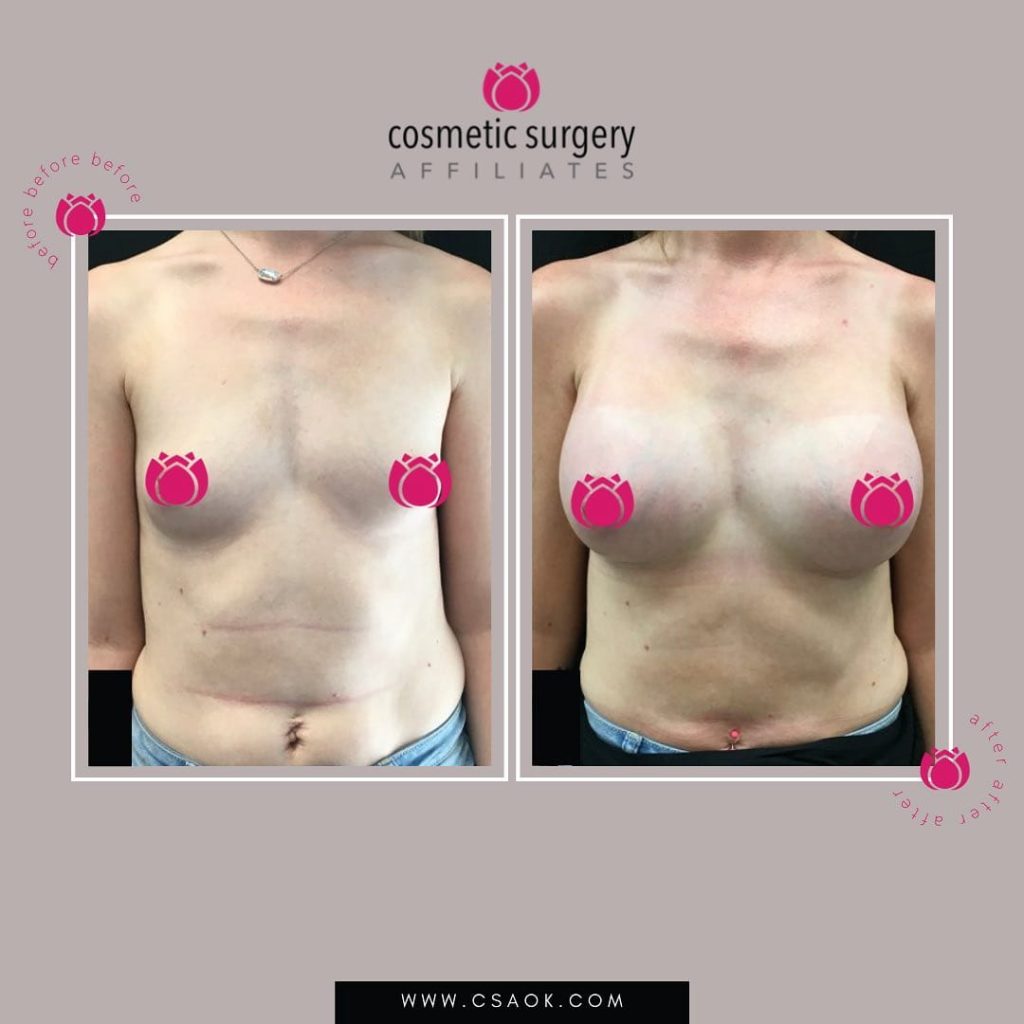
Significant swelling is present during the first week or two, which makes it impossible to judge your final size. You might think they look too big, too small, or oddly shaped. Bruising and tightness are common and usually resolve over two to four weeks.
If your implants were placed beneath the pectoral muscle (submuscular placement), the muscle needs time to relax and stretch around the implant. That’s why they sit so high initially, and it’s one of the most common reasons patients feel anxious during the first few weeks.
The most important thing to remember during this stage is simple: the shape you see right now is temporary. Your body is still healing, swelling is still present, and the implant hasn’t had time to settle. Give yourself permission to stop judging and start recovering.
What Is the “Drop and Fluff” Process, and Why Does It Matter?
If you’ve been researching breast augmentation results online, you’ve probably come across the phrase “drop and fluff.” The “drop” refers to the implant gradually descending from its initial high position as your muscle and tissue relax over time. The “fluff” refers to the lower pole of your breast filling out as the implant settles deeper into its pocket, creating a fuller, more natural shape.
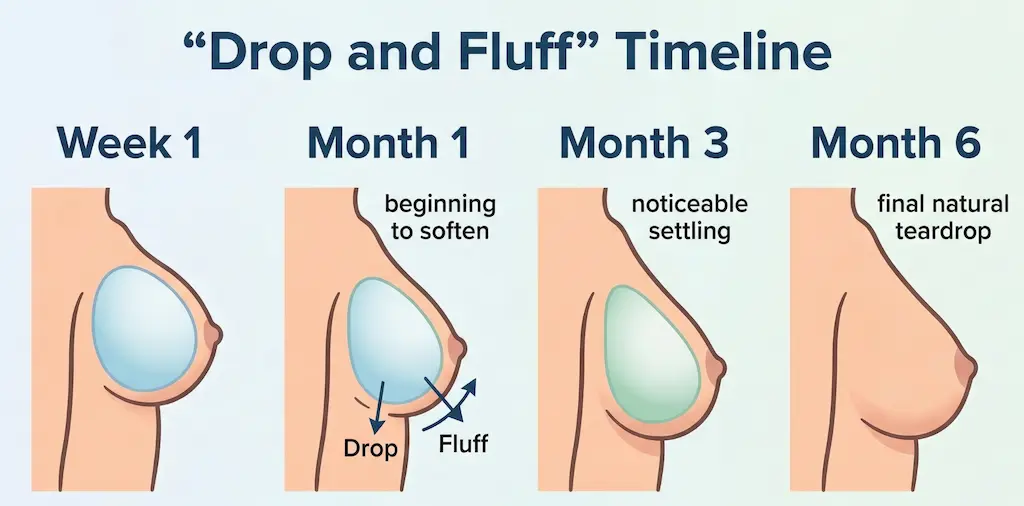
This process takes anywhere from three to six months, sometimes longer for submuscular placement. Signs that drop and fluff is happening include your upper pole becoming softer, the implant feeling less tight against your chest, and a more natural slope developing.
| Placement Type | Initial Appearance | Drop & Fluff Timeline | Final Result Timing |
| Submuscular (under muscle) | High, firm, round upper pole | 3 to 6 months | 4 to 6 months |
| Subglandular (over muscle) | More natural immediately | 6 to 12 weeks | 3 to 4 months |
| Dual plane | Moderate, between the two | 2 to 4 months | 3 to 5 months |
It’s completely normal to feel concerned around week three when your breasts still look uneven or too high. Most patients feel a wave of worry during this phase, wondering if something went wrong.
Be patient with your drop and fluff. Many patients message us concerned at week 3, but by month 4, they love their results. — CSA surgical team
If you’re curious about what the early recovery period looks like day by day, check out our article on recovery that breaks down the timeline in detail.
What Factors Affect How Your Results Look?
No two patients will end up with identical outcomes, even when the same implant type and size is used, because your body is unique to you. That’s not a limitation, it’s what makes your results yours. Understanding what influences your outcome can help you build expectations around your own body rather than someone else’s before and after photos, and that shift in perspective is one of the most powerful things you can do for your own satisfaction.
- Implant placement plays one of the biggest roles in how your results will look and feel over time. Submuscular placement, which is where the implant sits beneath the chest muscle, tends to produce a more natural appearance long term because the muscle acts as an extra layer of soft tissue coverage over the implant. This can be especially beneficial for patients with less natural breast tissue coverage, as it helps smooth out the edges of the implant and reduces visible rippling.
The trade off is that recovery can be a bit more intense, and you may experience an animation effect where the implant shifts slightly when you flex your chest. Subglandular placement, or where the implant sits above the muscle but beneath the breast tissue, offers more immediate fullness and a shorter, less uncomfortable recovery.
However, over time, implant edges may become more visible for patients with less natural tissue coverage. There’s also dual plane placement, which combines elements of both approaches, and your surgeon at an affordable breast augmentation OKC practice may recommend this depending on your anatomy and goals.
- Implant type shapes the overall look more than many people realize. Round implants are the most commonly used and create more upper pole fullness, that visible fullness across the top of the breast that many patients love. They also have the advantage of looking the same even if they rotate slightly within the pocket.
Anatomical implants, often called “gummy bear” implants because of their gel consistency, are designed to mimic the natural teardrop shape of the breast, with more volume concentrated toward the bottom. These can produce beautifully natural looking results, but they do require precise placement since any rotation could affect the shape.
- Implant size affects more than just how full your breasts will look. It also influences how long the settling process takes and what the journey to your final result feels like. Larger implants generally need more time to drop into their natural position and may sit noticeably high on the chest for the first several weeks or even months. This is completely normal, but if you’re not expecting it, the longer healing process can test your patience.
Smaller, more proportionate implants tend to settle faster and often blend more seamlessly with your natural frame. This is one of many reasons our guidance on sizing matters so much, what looks exciting in a fitting bra doesn’t always translate to the most satisfying long term result.
- Skin elasticity and natural tissue coverage directly impact how natural your final result looks and feels. If you have good skin elasticity and a moderate amount of natural breast tissue, implants tend to blend more smoothly, with softer transitions and fewer visible edges. Women with thinner skin or very little natural tissue may notice more of the implant’s outline, particularly along the sides or upper pole.
- Surgeon technique ties all of these factors together. Even the perfect implant choice won’t deliver great results without precise surgical execution. The way our surgeons create the pocket, position the implant, and account for any existing asymmetry between your breasts all play a significant role in your final appearance. We pay close attention to the small technical details, like how the inframammary fold is managed or whether the pocket dimensions match the implant. These things can make the difference between results that look effortlessly natural and results that need revision.
Our patient, Jessica, describes how important we make patient education in her review.
“I had breast augmentation on March 23 2017. Dr Nuveen was awesome. He was very helpful and made me feel very comfortable with the procedure. His staff was awesome also. Tiffany was very helpful and made sure I understood everything preop and postop. I would recommend Dr. Nuveen to anyone. Thanks everyone!!!”
Your body’s unique starting point, including your chest width, existing breast tissue, and natural symmetry, shapes the final outcome just as much as the implant itself. That’s why choosing the right breast implant size during consultation is one of the most important decisions you’ll make.
When Will You See Your Final Breast Augmentation Results?
This is one of the most common questions patients ask, and the honest answer requires patience. Most patients see results close to final by three months, with complete settling by six months. Some cases, particularly those involving larger implants, submuscular placement, or tight skin, can take up to 12 months.
| Timeline | What You See | What’s Happening Internally |
| Day 1 to 7 | Breasts are very swollen, high, tight. May look too big or too small. | Peak swelling. Muscles in protective spasm. Incisions healing. |
| Week 2 to 4 | Swelling decreasing. Breasts still high but beginning to soften. May notice one side dropping faster. | Muscle relaxation is starting. Skin begins to stretch. One side often leads, and that’s normal. |
| Week 4 to 8 | Shape changing noticeably. Upper fullness softening. Lower breast filling out. | Implants descending into pocket. Tissue adapting. Scar tissue (capsule) forming around the implant. |
| Month 3 to 6 | Significant settling. Natural teardrop shape. A softer feel. Position stabilizing. | Final drop and fluff occurring. Capsule maturing. Implant position becoming permanent. |
| Month 6 to 12 | Subtle continued refinement. Scars fading. True final result. | Complete tissue integration. Scar maturation. Minor settling may continue. |
It’s completely normal to feel anxious during the waiting period, especially when one breast seems to be settling faster than the other.
If you notice that one breast looks different from the other during healing, you’re not alone. Asymmetry is one of the most common concerns patients bring up, and it can be genuinely unsettling. It’s completely understandable to feel anxious about it, especially when you’ve invested so much emotionally and financially in this decision.
Thankfully, in most cases, it resolves on its own. Your breasts may settle at different rates, one might drop into position weeks before the other, and it can take up to six months or even longer before everything evens out. It’s one of those moments where patience really is the kindest thing you can give yourself.
What Results Are Realistic, and What Expectations Are Unrealistic?
Breast augmentation enhances your natural proportions. Although it’s normal to look at the bodies of influencers, celebrities, and even people in your life and wish that your body could look like theirs, it’s important to remember that breast augmentation won’t be able to do exactly that. It doesn’t give you someone else’s breasts or create a level of perfection that doesn’t exist in nature.
Breast augmentation surgery is best when it’s tailored to your body and enhances your natural beauty, not somebody else’s. Understanding the difference between realistic and unrealistic expectations is one of the strongest predictors of satisfaction after surgery. That same clarity helps patients evaluate alternatives — our injectable breast augmentation guide breaks down which non-surgical options actually deliver results and which don’t.
It’s easy to fall down a rabbit hole of before and after photos and start comparing yourself to every result you see. But your anatomy, tissue, and body shape are unique to you, and the best results will always be the ones that work with what you have.
To help you get a clearer picture of what that looks like in practice, here’s a side by side look at what breast augmentation can and can’t do, not to dampen your excitement, but to help you walk into your consultation feeling informed and empowered:
| Realistic Expectations | Unrealistic Expectations |
| Fuller, more proportionate breast size | An exact cup size guarantee (bra sizing varies too much between brands) |
| Improved symmetry, though not perfection | Perfectly identical breasts (natural asymmetry always remains) |
| Restored volume after pregnancy, weight loss, or aging | Complete elimination of sagging without a breast lift |
| More clothing options and better fit | Results that match a celebrity or friend (your anatomy is unique) |
| Natural movement and feel when properly sized | Cleavage like push-up bra photos (depends on natural spacing) |
| Increased confidence and body satisfaction | No visible changes over time (aging, gravity still occur) |
| Visible improvement in breast shape and contour | Instant final results (drop and fluff takes months) |
The best results match your body’s proportions, not social media photos or someone else’s outcome.
How Do Pregnancy, Weight Changes, and Aging Affect Long Term Results?
Breast augmentation creates a beautiful, lasting enhancement, but it’s important to go in knowing that your body will keep doing what bodies do. Your implants won’t stop the clock on aging, gravity, or the natural changes that come with living your life. And that’s not a flaw in the procedure, it’s just reality.
The women who tend to feel happiest with their results long term are the ones who understood this from the beginning, and that’s why we try our hardest to make sure that you’ll know everything you need to know to be prepared.
A lot can happen over a person’s lifetime, so let’s look at some of the ways that the future can potentially affect your implants, how it happens, and what you can do.
Pregnancy and Breastfeeding
If having children is part of your future, this is worth thinking through. During pregnancy, your breasts will enlarge as they always would, stretching the skin around your implants. When your milk comes in, engorgement happens normally.
Implants don’t interfere with that process, and most women with implants are able to breastfeed without issues, though some may experience reduced milk supply depending on incision type. What happens afterward is where things get more individual. Some women wean their babies and find that their augmented breasts still look wonderful. Others notice changes in shape, volume, or symmetry that weren’t there before.
If you’re planning on having multiple children, it’s worth knowing that revision surgery is sometimes part of the picture later on, but it’s far from inevitable. This is a great topic to talk about with us during your consultation or follow up appointment, especially when it comes to timing your procedure around your family plans.
Weight Fluctuations
Your implants stay the same size, but the natural tissue around them doesn’t. When you gain weight, your body adds tissue around the implant, which can change the overall proportions and fullness of your breasts in ways you might not expect.
When you lose weight, that natural tissue decreases, and the implant may become slightly more visible. Some women describe their breasts feeling or looking more “implant like” after significant weight loss.
If your weight tends to fluctuate considerably, it’s also worth knowing that repeated cycling between gain and loss can stretch the skin over time, potentially contributing to sagging. None of this is meant to discourage you, but we want you to have all the information that helps you plan realistically so you’re not caught off guard later.
Most patients love their results long term, and the need for revision isn’t guaranteed. If concerns do arise, revision surgery can address issues like size change, implant malposition, capsular contracture, or changes from pregnancy and aging. We’re here for you if ever any of these concerns arise, or if you’d like a change.
Our patient, Shannon, was satisfied both times we operated on her:
“Dr Nuveen did my first breast augmentation and he did a great job, but his wife Dr Caplin did an even better one this time around at making sure I was going to be happy with my end results! Very much pleased with my outcome! Thank you.”
The good news is that when revision is needed, it’s a well understood procedure with predictable outcomes, and going into your initial augmentation with the right information can significantly reduce the chances you’ll ever need one.
If revision is still something you’re thinking about, or just want to be prepared for, here are a few things worth keeping in mind:
- Wait at least six to 12 months before making any revision decisions, since early dissatisfaction often resolves as implants finish settling
- One of the most common reason for revision is a change in size preference, not a complication
- Prevention starts with thorough consultation, clear communication about your goals, your anatomy, and the timeline for final results from the beginning.
At Cosmetic Surgery Affiliates, our surgical team will walk you through every decision during consultation and support you throughout the entire process, including discussing revision options if they ever become necessary.
Conclusion
Breast augmentation results develop gradually over weeks and months, not overnight. Understanding how your unique anatomy influences your outcome are the best ways to ensure long term satisfaction. The patients who feel most confident in their results are the ones who went in informed and gave their body time to heal.
We here at Cosmetic Surgery Affiliates, top rated cosmetic surgery OKC patients recommend, believe every patient deserves to feel heard, respected, and confident in their choices, and our goal is to make sure our patients are satisfied with their final results.
If you’re still feeling unsure after you’ve given your body time to heal and settle into its new shape, or if you’re considering further changes, you can schedule a follow up appointment or book a virtual consultation here.
Disclaimer – This content is for educational purposes only and does not constitute medical advice. A consultation with a qualified board-certified surgeon is required to determine the best treatment plan for your individual needs and any questions you may have about a medical condition or procedure.
Frequently Asked Questions
When will my breast implants look natural after surgery?
Most implants begin looking natural around three to four months as the body heals and changes, with full settling by six months. Submuscular placement takes slightly longer because the pectoral muscle needs more time to relax.
Can breast augmentation fix sagging, or do I need a lift too?
Implants add volume but don’t lift sagging tissue. If you have significant drooping, your surgeon will likely recommend combining augmentation with a lift from a top breast lift surgeon near you for the best results.
What happens if I don’t like my results or they’re not what I expected?
Wait at least six months before making any decisions, since early results rarely reflect the final outcome. If concerns remain after full settling, revision surgery can adjust size, shape, or positioning.
How do I know if my implants have settled properly?
Settled implants feel soft, sit naturally on your chest, and have a comfortable, balanced appearance. Your surgeon will confirm proper settling at your follow up appointments.
What if one breast looks different than the other during healing?
Asymmetry during healing is one of the most common concerns and is almost always temporary. One breast often drops faster than the other, and they typically even out by month three to six.