
Three questions come up in almost every liposuction consultation, and none of them are about the surgery itself. Will this help me lose weight? Will it smooth the dimpling on the backs of my thighs? And what will I actually see in the mirror six months from now?
Those questions deserve straight answers, and the real ones are narrower than most people expect. Liposuction does one thing exceptionally well, and several closely related things not at all.
Cellulite is a good example, because it has an entire treatment category of its own. ISAPS counted 331,981 non-surgical cellulite treatments worldwide in 2023, a category that sits apart from liposuction. That separation exists for an anatomical reason.
At Cosmetic Surgery Affiliates in Jacksonville, our board-certified cosmetic surgeons would rather answer these questions before surgery than explain them afterward. This article covers what liposuction does to the scale, why it doesn’t erase dimpling, and what your results look like month by month. You’ll also learn what recovery involves.
Key takeaways
- Liposuction removes the soft fat just under your skin, not the deeper fat around your organs. It reshapes your proportions without meaningfully changing the scale.
- Surgeons cap fat removal at about five liters, roughly ten pounds, per procedure. That limit protects you.
- Cellulite dimpling comes from fibrous bands tethering your skin from below, not from the fat liposuction reaches. Removing fat leaves the bands, and the dimples, where they were.
- Your skin’s elasticity, more than the volume of fat removed, decides whether the treated area looks smooth.
- Early shape appears within weeks, but the contour keeps refining for three to six months as swelling resolves.
Does liposuction work as a weight loss procedure?
No, and that answer disappoints people until they see what it buys them instead. Liposuction is a contouring procedure. It reshapes where your body carries fat rather than reducing what your body weighs.
The distinction lies in which fat layer a surgeon can actually reach.
| Subcutaneous fat | Visceral fat | |
|---|---|---|
| Where it sits | Just beneath the skin, the layer you can pinch | Deeper in the abdomen, wrapped around the organs |
| Reachable by liposuction | Yes | No |
| What shifts it | Surgery, plus diet and exercise | Diet, exercise, and medical care |
Contouring versus weight loss
Most people are startled by how little the scale moves. Surgeons generally remove no more than about five liters of fat and fluid in one procedure, which is roughly ten pounds at the absolute maximum. Most procedures come nowhere near that ceiling, and much of what leaves the operating room is fluid rather than fat.
So the scale barely moves. Your waistband, meanwhile, can shift a full size. That gap between weight and shape is the whole point.
The fat liposuction cannot reach
Visceral fat, the deeper kind that wraps around your organs, is the fat most closely tied to metabolic health. A surgeon’s instruments cannot safely reach it, and no amount of liposuction will reduce it.
This is why liposuction isn’t a treatment for obesity or metabolic conditions. A landmark New England Journal of Medicine study removed large volumes of subcutaneous fat from women with obesity.
It found no improvement in insulin sensitivity or in the blood markers tied to heart disease. The fat came off. The metabolic picture stayed the same.
The role of your goal weight
Being at or near a weight you can hold steady protects your result. When your weight is settled, your surgeon can see your true contour and sculpt it.
Triple board-certified cosmetic surgeon Dr. Courtney Caplin evaluates your health, the areas you want treated, and how much fat can safely come from each one. The plan gets built around your anatomy, not around a number.
Once weight is off the table, the next question is almost always about skin.
Does liposuction get rid of cellulite?

It doesn’t, and the reason has nothing to do with how much fat comes out. Cellulite isn’t really a fat problem. It’s a tethering problem.
The anatomy behind the dimples
Beneath your skin, fibrous bands run downward like tent ropes, anchoring the skin to the tissue below. Fat pushes up between them. The bands hold their anchor points down, and the result is the quilted, dimpled surface you recognize.
Liposuction removes the fat between those bands. It leaves every band exactly where it was.
Dimpling that becomes more visible
Here’s the part that surprises people. Removing fat can occasionally make existing dimples more noticeable, because that fat was partially filling the spaces between the bands.
Take the volume away and the skin drapes more closely over the tethers. The American Board of Cosmetic Surgery says as much in its myth guide, noting that removing the fat layer beneath the skin may actually worsen the dimpled look. It’s uncommon and predictable, and an experienced, board-certified surgeon will flag the risk before you commit.
A 2024 study in the Journal of Clinical and Aesthetic Dermatology classified post-liposuction skin irregularities as a distinct complication, one that closely resembles cellulite.
Factors behind a smooth surface
Several factors shape the final surface, and only some are controllable:
- Skin elasticity, meaning how readily your skin retracts over a smaller volume
- Age, which gradually reduces that elasticity
- How evenly the fat is taken from each layer
- Whether significant weight fluctuation follows
- Whether skin-tightening technology is used alongside
Skin elasticity is the biggest factor by far. Skin that retracts readily settles into a smooth surface. Skin with less give may show mild unevenness as swelling goes down, a normal part of how tissue re-drapes.
Skin tightening alongside liposuction
Treatments built specifically for cellulite work by releasing the fibrous bands rather than by removing fat. That’s a different procedure with a different goal.
What pairs naturally with fat removal is skin tightening. Renuvion skin tightening delivers radiofrequency energy and cooled helium plasma beneath the skin, stimulating collagen and tightening its internal structure. Combined with liposuction, it adds only a few minutes.
It won’t erase dimpling. It can meaningfully improve how tightly your skin conforms to the shape underneath.
That brings us to the question everyone is really asking.
What results can you realistically expect from liposuction?
A visibly reshaped area that keeps refining for most of a year. Not a smaller number on the scale, and not tighter skin than you started with. What changes is your silhouette, in the places you asked your surgeon to treat.
| Timeframe | What you’ll notice |
|---|---|
| First week | Tightness and swelling, with a puffy, firm feel |
| Weeks 2 to 6 | Bruising clears and an early shape emerges beneath residual swelling |
| Months 3 to 6 | Most swelling resolves and the contour becomes stable |
| Around 12 months | The last refinement, as skin finishes re-draping |

The timeline to your final contour
Early changes show up within a few weeks, which is reassuring. The honest timeline is longer. Most swelling clears between three and six months, and the finest details settle out to around the twelve-month mark.
Patience here isn’t a platitude. Judging your result at week three means judging swelling, not shape.
Skin quality and the smoothness of your result
Fat removal changes volume. Your skin has to accommodate the smaller shape underneath, and how gracefully it does that comes down to elasticity.
Skin that retracts well settles into a smooth, even contour. Skin with less natural recoil may stay slightly loose, because liposuction removes fat and never removes skin. When there’s meaningful laxity to address, a tummy tuck is the tool that does that job.
Weight changes and your contour
The fat cells your surgeon removes are gone from that area. The fat cells everywhere else in your body remain, and those cells can still enlarge if your weight climbs meaningfully.
That’s why holding a steady weight protects the shape you worked for. In a six-month randomized trial, women who began a structured exercise program two months after abdominal liposuction avoided a compensatory rise in deeper visceral fat. The non-exercising group did not. Movement after surgery does real work.
Reading before-and-after photos honestly
The most useful photo isn’t the most dramatic one. It’s the one whose “before” resembles your own starting point.
When you look through the before-and-after gallery at Cosmetic Surgery Affiliates, search for a starting point like yours rather than an ending you admire. The gap between two “afters” is usually a gap between two “befores.”
Ashley, who had liposuction on her inner thighs and knees alongside skin tightening, shared her experience:
“I had a belt lipectomy/lower body lift, Renuvion on inner thighs with Lipo on inner thighs and knees. She listened patiently to my concerns and made me feel so at ease throughout the whole process. Dr Caplin has impeccable surgical skills, meticulous attention to detail and the outcome well supercedes my expectations!”
What does recovery after liposuction look like?
Manageable, uncomfortable for about a week, and less dramatic than most people brace for. A 2023 analysis of more than 246,000 outpatient liposuction procedures in accredited surgical facilities found serious issues to be genuinely uncommon.
The first week
Swelling peaks around the two-day mark, then improves steadily. The treated area feels tight and sore, closer to the ache of a hard workout than to sharp surgical pain.
You may notice fluid draining from the small openings for a few days. That’s a mix of the numbing solution injected before surgery and a little blood, and absorbent pads under your garment handle it easily.
Weeks two through four
Soreness fades, bruising clears, and the early shape starts showing through the remaining swelling. Most people are back at a desk job within one to two weeks, and some feel ready sooner.
Physically demanding work waits longer. Four to six weeks is typical before a surgeon clears heavy lifting or high-impact activity. Light walking in the meantime is one of the two best things you can do.
Compression garments
The other best thing is the garment. Wearing it as directed shortens swelling, supports healing tissue, and begins shaping your new contour from day one.
Expect to wear it around the clock for the first one to three weeks, removing it only to shower. From there it steps down to daytime wear, then to nights only. A day-by-day recovery timeline makes that schedule easier to follow.
A few things reliably help during those first weeks:
- Walking gently and often, starting the day after surgery
- Wearing the garment on the schedule your surgeon sets
- Sleeping with the treated area slightly elevated
- Staying hydrated, which helps clear retained fluid
- Keeping every follow-up appointment
The role of surgical drains
Temporary drains aren’t routine. They’re reserved for large-volume procedures, and most people having one or two areas treated never see one.
If your plan calls for a drain, your surgeon walks you through it well before the day of surgery. Nothing about recovery should be a surprise, which is precisely what a consultation is for.
What should you expect at your consultation?
A conversation, not an evaluation you can fail. Your surgeon assesses your anatomy, your skin quality, and your general health. You get to assess them right back, and both matter equally.
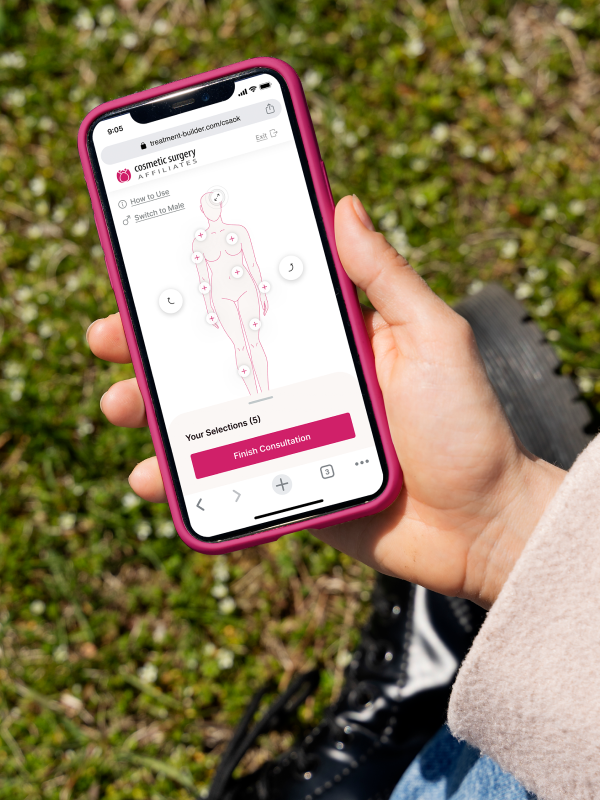
At Cosmetic Surgery Affiliates, the first visit is a private discussion about what’s been bothering you. Your surgeon asks questions, explains which options fit your anatomy, and builds a plan around them. Nothing is off limits, and nobody expects you to decide that day.
Choosing an accredited surgical facility and a board-certified surgeon is the most protective decision you make before any procedure. Accreditation holds the operating room to national safety standards, and board certification means formal training in the procedure you’re considering. Ask a surgeon about both.
You can start in person at our Jacksonville office, or begin with a virtual consultation from home. Cost comes up in that same visit, and flexible financing through PatientFi and Alphaeon makes the plan workable rather than aspirational.
Shaun, whose wife was told honestly what her recovery would involve, shared their experience:
“Even late at night after surgery, Dr. Courtney would personally answer phone calls and texts whenever we were worried something looked off during recovery. She always brought a calming presence and reassured us while still being honest and upfront about the recovery process and any hardships my wife might face.”
If you’d like that conversation, book your consultation and come with your questions written down.
Conclusion
The honest version of liposuction is narrower than the marketing version, and considerably more useful. It reshapes the areas that diet and exercise haven’t touched. It doesn’t move the scale, release the bands that cause dimpling, or tighten skin that has lost its recoil.
Knowing that before you sit down with a surgeon lets you ask better questions and recognize a truthful answer when you hear one.
The surgeons at Cosmetic Surgery Affiliates believe every patient deserves to feel heard, respected, and confident in what they’ve chosen. Whether you’re ready to talk through a specific area or just want to understand where you stand, that conversation is yours.
Frequently asked questions
Can you get liposuction if you are overweight?
Liposuction isn’t a treatment for obesity, and carrying significant excess weight usually means the timing isn’t right yet. The best candidates are at or near a weight they can hold steady, with pockets of fat that haven’t responded to diet and exercise. Personalized weight loss treatment is available for patients who want to reach that point first.
Does liposuction remove visceral fat around your organs?
No. Liposuction reaches only the subcutaneous layer, the soft fat just beneath your skin. Visceral fat wraps around the organs deeper in your abdomen, and surgical instruments cannot safely reach it. That deeper fat responds to diet, exercise, and medical management instead.
How much fat can be safely removed during liposuction?
About five liters, roughly ten pounds, is the generally accepted maximum for one procedure. The American Society of Cosmetic Surgeons recommends staying within that limit for patient safety. Most procedures remove considerably less.
Does liposuction get rid of cellulite on the thighs and buttocks?
It doesn’t, on any part of the body. Cellulite is caused by fibrous bands that tether the skin from below, and liposuction removes the fat between those bands without touching the bands themselves. In some cases, taking away that fat makes existing dimples slightly more visible rather than less.
Does laser liposuction work better than traditional liposuction for cellulite?
Not meaningfully. Laser-assisted, ultrasound-assisted, and traditional techniques all remove the same subcutaneous fat layer, and none release the fibrous bands behind the dimpling. Technique still matters for precision and bruising. It just doesn’t turn liposuction into a cellulite treatment.
Can liposuction help tighten loose or sagging skin?
Liposuction removes fat and does nothing to remove excess skin. Skin with good elasticity retracts well over the smaller contour on its own. When there’s meaningful laxity, surgeons pair fat removal with skin-tightening technology like Renuvion, or recommend a skin-removal procedure such as a tummy tuck.
Will your skin look bumpy or uneven after liposuction?
Mild unevenness while swelling resolves is a normal part of healing, and it settles over the first few months. Persistent irregularity is uncommon and usually reflects skin elasticity. Revision liposuction exists specifically to correct lumps, uneven bulges, and poor contours from an earlier procedure.
What happens if you gain weight after liposuction?
The fat cells removed from the treated area are gone, but the fat cells throughout the rest of your body remain and can enlarge. Significant weight gain can therefore change your contour, sometimes in ways that look disproportionate. Staying within five to ten pounds of your post-surgical weight keeps the shape your surgeon created.
Can liposuction be combined with a tummy tuck?
Yes, and it’s one of the most common pairings, because the two procedures solve different problems. Liposuction sculpts the fat while a tummy tuck removes loose skin and repairs separated muscle. A virtual or in-person consultation is where you work out whether combining them fits your anatomy. Financing through PatientFi and Alphaeon can spread the cost of a combined plan.
*Disclaimer: This content is for educational purposes only and does not constitute medical advice. A consultation with a qualified board-certified surgeon is required to determine the best treatment plan for your individual needs and any questions you may have about a medical condition or procedure.