
Liposuction technology gets marketed a lot like phone specs. VASER, SmartLipo, power-assisted, water-jet, every name promising something the others supposedly can’t do. Read enough of it and you’d be forgiven for thinking the machine picks your result.
The devices genuinely are different from one another. What they change, though, is rarely the thing patients expect walking in.
Liposuction is also one of the most performed operations on the planet. In 2023 it was the single most common surgical cosmetic procedure worldwide, with more than 2.2 million performed, according to ISAPS. Decades of that volume pushed the equipment from a plain suction tube into the range of tools a surgeon reaches for today.
At Cosmetic Surgery Affiliates in Oklahoma City, our board-certified cosmetic surgeons have cared for more than 27,000 patients, and choosing the right instrument is part of every surgical plan. This article opens up the machine itself. You’ll learn what the pump, the canister, and the cannula each do, how the four named technologies differ, and how the whole setup is run safely.
Key takeaways
Short on time? Here’s the heart of what this guide covers about liposuction equipment, from the parts inside the machine to how your surgeon picks between them.
- Every liposuction system is built from the same four parts, whatever its branding: a vacuum pump, a collection canister, a hollow tube called a cannula, and the controls the surgeon uses to modulate suction.
- The named technologies differ only in how they loosen fat before it’s suctioned. Power-assisted vibrates the cannula, ultrasound uses sound waves, laser uses heat, and water-jet uses a pulsing stream of saline.
- Heat is what drives skin retraction, so laser and ultrasound offer some tightening. Power-assisted and traditional methods generate no heat, and tighten far less.
- The tumescent solution injected before suction begins numbs the area, shrinks blood vessels to limit bleeding, and firms the tissue so fat breaks apart predictably.
- The device matters less than the setting and the surgeon. Suction pressure, fluid balance, and total volume removed are tracked in real time, and an accredited operating room makes that monitoring meaningful.
What’s actually inside a fat suction machine?

Strip away the branding and every liposuction system is built from the same handful of parts. A pump creates suction, a canister catches what comes out, a thin tube does the work inside the body, and the surgeon runs it all from a console. The named technologies are additions to this core, not replacements for it.
| Component | What it does |
|---|---|
| Aspirator pump | Creates and holds the vacuum that draws fat out |
| Collection canister | Catches and measures the fat and fluid removed |
| Cannula | The hollow tube that loosens and carries out fat |
| Handpiece and console | Where the surgeon adjusts suction and activates the device |
The vacuum pump
The pump is the engine. It runs continuously through a procedure lasting one to four hours, holding a steady negative pressure so fat moves out through the cannula without the surgeon forcing it.
That even pull is why mechanical suction replaced hand-held syringes for most cases. A syringe still has its place in delicate work and in fat grafting, where gentler handling protects the fat cells being harvested.
The collection canister
Everything that leaves your body lands in a clear, graduated canister beside the table. The markings on its side let the surgical team read, in real time, how much has come out.
Fat and fluid separate naturally in there, the lighter fat rising above the tumescent saline and blood. That separation is what distinguishes actual fat volume from the fluid injected minutes earlier.
Cannulas and their tips
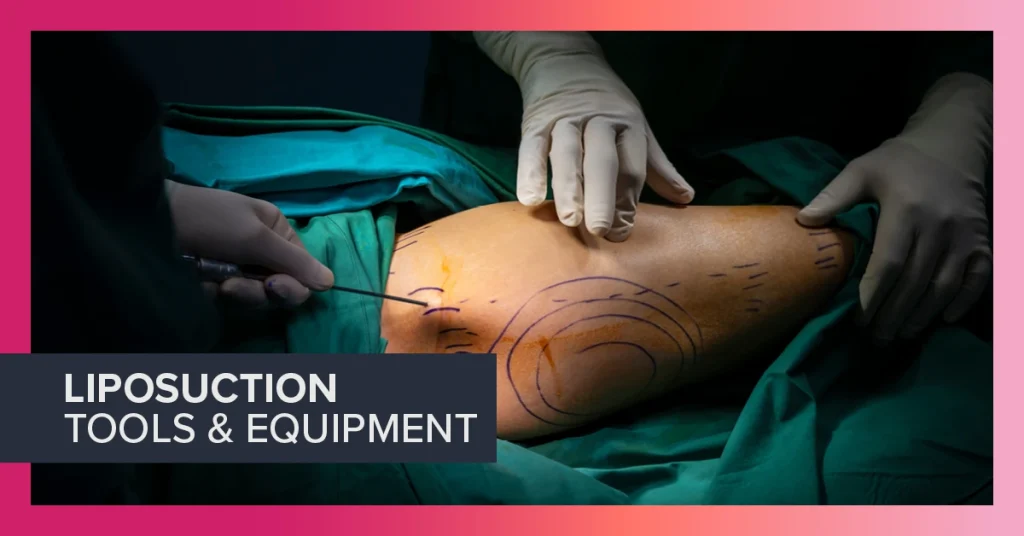
The cannula is a hollow tube with openings near its tip. It enters through openings in the skin measuring roughly three to six millimeters, small enough to sit in natural creases where they fade.
Diameter and tip shape are the real variables. Thinner cannulas with blunt, rounded tips move around nerves and vessels instead of through them, which is why modern instruments trend smaller than the tools of thirty years ago.
The surgeon’s controls
Suction strength isn’t fixed. Your surgeon dials it up or down at the console, then triggers the device with a foot pedal or a control in the handpiece, leaving both hands free.
That tactile feedback matters more than any setting. One hand steers the tube through the deep fat layer first, then the superficial layer, while the other reads the contour from above. Once you understand that baseline, the branded technologies start making sense.
How does power-assisted liposuction improve on traditional methods?
Power-assisted liposuction, usually shortened to PAL, adds a small motor that vibrates the cannula tip back and forth in rapid, tiny strokes. Nothing else about the system changes. The tube still enters through the same small openings, and the same pump still does the suctioning.
What changes is effort. In traditional liposuction the surgeon supplies every bit of the back-and-forth motion by hand, thrusting the cannula through tissue hundreds of times. The motor takes over that repetitive movement, so the cannula slides through fat rather than being pushed through it.
The efficiency gain is measurable. A 2025 review reports that power-assisted systems aspirate 31 percent more fat per minute than manual technique, cutting procedure time by about 35 percent.
Less time under anesthesia is a real benefit for you. A steadier, less fatigued surgeon in hour three is arguably a bigger one. That vibration also shears fat cells cleanly rather than tearing them loose, which tends to mean less bruising.
PAL earns its keep where fat is dense and fibrous, the places manual technique has to fight through:
- The male chest, where gynecomastia tissue is notoriously tough
- The back and the flanks
- The hips and outer thighs
- Sessions where several areas are treated in one appointment
One more thing worth knowing. PAL creates no heat, so the burn concerns that come with energy-based devices don’t apply to it.
Vibration only loosens fat mechanically. The next generation of devices took a different route and started using energy.
How does ultrasound-assisted liposuction use sound waves to break up fat?
Ultrasound-assisted liposuction, or UAL, sends sound waves through the treatment area before any fat is suctioned out. The energy makes tiny gas bubbles in the fluid rapidly expand and collapse, and that microscopic churn breaks fat cells apart where they sit. Surgeons call it emulsification, a technical way of saying the fat turns from solid clusters into something closer to liquid.
VASER is the best-known version. The name stands for Vibration Amplification of Sound Energy at Resonance, and it works through a grooved probe tuned to a frequency that fat responds to.
Here’s the elegant part. Fat is soft and full of those responsive microbubbles, while blood vessels, nerves, and connective tissue are dense and elastic. The energy destabilizes the first and leaves the second largely intact, which is why surgeons reach for ultrasound when precision matters.
The surgical team performs VASER liposuction and matches it to the tissue in front of them. Fibrous areas like the back and the male chest are where it shines. Preserving surrounding tissue also means less blood loss and fat cells intact enough to be reused in a fat transfer.
Ultrasound probes do generate heat, and heat has to be respected. The reassuring news is that the protocols for managing it are well established. A 2024 study of 1,486 VASER cases recorded minor issues in about three percent of patients, with no burns and no major complications in any of them.
Those protocols are practical, not exotic. Tumescent fluid acts as a heat sink so no pocket of tissue overheats, protective sleeves guard the skin at each entry point, and your surgeon keeps the probe moving.
Joann, who had liposuction alongside her tummy tuck and cared most about a smooth, even result, shared her experience:
“I’m very pleased with my tummy tuck and liposuction procedure! Dr. Nuveen and his team (Meg, Ashley, Amber) were so kind and helpful in answering questions. As soon as I saw the results during the follow up appointment I was delighted to see the smooth stomach! I was going to post my before and after photos here, but they are a little private, but I’d be happy to share with anyone thinking of doing the surgery here and wanting some reference of a happy and well done procedure! Thank you very much Dr. Nuveen! This has been a very positive experience! 😀”
Sound waves aren’t the only way to put energy into fat. Lasers do it with light, and the tradeoffs shift again.
How does laser-assisted liposuction use heat energy?
Laser-assisted liposuction, abbreviated LAL, threads a hair-thin fiber through the cannula and delivers laser light into the fat layer. Specific wavelengths are absorbed strongly by fat and barely at all by the tissue around it, so the energy lands where it’s aimed. The fat warms, its cell membranes give way, and it becomes easy to suction.
Heat brings two side effects that surgeons deliberately exploit. One is that certain wavelengths are absorbed by hemoglobin in small blood vessels, sealing them as the fiber passes and leaving less bruising behind. The other is collagen.
Warming the underside of the skin to a controlled temperature prompts your body to lay down new collagen over the following months. A 2026 systematic review calculated an average skin retraction of about 30 percent for laser-assisted liposuction, against roughly 12 percent for traditional suction alone. Its authors are careful to note that the underlying studies vary widely, so treat those figures as a direction rather than a promise.
That’s why laser devices, SmartLipo among the most recognized brand names, get discussed for smaller areas where loose skin is the real complaint. The chin and the upper arms come up most often.
The same heat that tightens skin has to be bounded, and it is:
- Skin surface temperature is held in a narrow window and watched throughout
- Internal tissue temperature is capped below the point where injury occurs
- Modern laser handpieces carry sensors that feed temperature readings back in real time
- Tumescent fluid, again, spreads and absorbs excess heat
It’s worth being honest about what any of this can do. Liposuction on its own doesn’t tighten skin, and laser energy produces a modest effect suited to mild laxity. Where a patient needs more, our surgeons often pair fat removal with Renuvion skin tightening, which uses J-Plasma technology to tighten the supportive network beneath the skin.
Cost naturally enters the conversation once you start comparing techniques, and it shouldn’t be what stops you from asking. You can view financing options before your consultation.
Heat is one way to make fat easier to remove. A fourth approach avoids energy altogether.
How does water-jet assisted liposuction loosen fat more gently?
Water-jet assisted liposuction, or WAL, uses a pulsing, fan-shaped spray of sterile saline instead of vibration, sound, or heat. The stream washes fat cells out of the connective-tissue scaffolding that holds them, a bit like rinsing berries loose from a colander rather than scraping them out.
The cannula is dual-purpose, which is the clever bit. One channel sprays fluid while another suctions the freed fat, so infiltration and removal happen together rather than in two stages.
That choice has consequences. Traditional technique saturates the area with fluid first and waits for the tissue to swell. WAL works on tissue that was never bloated, so less fluid goes in, and the fat that comes out is undamaged enough to graft elsewhere.
Water-jet systems aren’t widely used in the United States, and most patients here will never be offered one. Their strongest niche is lipedema, a chronic fat-distribution condition where gentleness genuinely changes the outcome.
| Approach | How it loosens fat | Best suited for | Skin retraction |
|---|---|---|---|
| Traditional (SAL) | Manual cannula movement | General contouring, large volumes | Minimal |
| Power-assisted (PAL) | Vibrating cannula tip | Fibrous fat, multiple areas | Minimal |
| Ultrasound (VASER) | Sound waves emulsify fat | Precision sculpting, fibrous zones | Moderate |
| Laser (SmartLipo) | Heat melts fat and warms skin | Small areas, mild laxity | Moderate to good |
| Water-jet (WAL) | Pulsing saline detaches fat | Lipedema, fat grafting | Minimal |
Five approaches, five sets of tradeoffs, and not one of them works without the room and the routine built around it.
How is a liposuction machine set up and run safely?

Before a single device is switched on, your surgeon infiltrates the treatment area with a tumescent solution. It’s a dilute mix of lidocaine to numb the tissue, epinephrine to constrict blood vessels and limit bleeding, and saline to firm everything up. Saturating the fat layer takes fifteen to thirty minutes, and the numbness carries you through the first twelve to twenty-four hours afterward.
Only then does the equipment come into play. Suction systems are tested and calibrated before every case, and the vacuum is dialed to the pressure that matches your tissue rather than run wide open.
Throughout the procedure the surgical team is doing arithmetic. Every milliliter of fluid going in and every milliliter of fat and fluid coming out gets recorded against the other, using those graduated canisters. Fluid balance is the number that protects you, and it’s watched continuously.
Volume has firm boundaries too. The American Society of Cosmetic Surgeons advises against removing more than ten pounds of fat in one session, and the surgeons here typically treat three to four areas per appointment for that reason. Broader guidelines treat aspirates over 5,000 cc as large-volume liposuction, calling for an accredited facility and closer monitoring.
Choosing an accredited surgical facility and a board-certified surgeon is the most protective decision you make before any procedure. Accreditation holds the operating room to national safety standards, and certification means formal training in what you’re about to have done.
Experience does the rest. Triple board-certified, fellowship-trained cosmetic surgeon Dr. Erik Nuveen has performed more than 26,000 major cosmetic surgeries since 2003. That volume is what turns a technique catalog into judgment.
Sabrina, who had liposuction under the chin and remembers the team more clearly than the equipment, shared her experience:
“I recently had a platysmaplasty with liposuction to remove my double chin. Dr. Meyer did an excellent job and I LOVE my result. She and her team were all so unbelievably kind and helpful. From Audra, my consultant to Brenda, one of my amazing nurses, everyone there made this a 10/10 experience for me. I highly recommend Dr. Meyer and Cosmetic Surgery Affiliates.”
Knowing what the machines do is useful. Knowing what to ask about them is where it pays off.
What should you ask about technology at your consultation?
A consultation isn’t only a chance for a surgeon to evaluate you. It’s your chance to evaluate them, and the questions you ask about equipment reveal how a practice thinks.
Start by asking to see results, then work backward to the technology that produced them:
- Ask to see before-and-after photos of patients with a body area and tissue type similar to yours
- Ask which technique the surgeon recommends for you, and what made them rule the others out
- Ask whether skin quality factors into the plan, and whether a tightening step is suggested
- Ask where the procedure will be performed and how many areas can safely be treated at once
The answers should be specific to your anatomy. A surgeon who recommends the same device to every patient is telling you something about the practice, not about your body.
Cost deserves the same directness. At Cosmetic Surgery Affiliates, liposuction is priced by treatment area rather than by device, with the first area running $5,600 to $8,600 and each additional area running $2,500 to $5,500. Flexible financing through PatientFi and Alphaeon spreads that across monthly payments.
Conclusion
Modern body contouring technology is genuinely impressive, and it’s also genuinely oversold. Every system removes fat through a thin tube attached to a pump, and the branded names describe only how that fat gets loosened first. Vibration, sound, heat, and water each earn their place in specific tissue, and none is universally better than the others.
Which is why the person selecting the instrument will always matter more than the instrument. At Cosmetic Surgery Affiliates, every patient deserves to feel heard, respected, and confident in the plan they walk out with. Whenever you’re ready to see what that plan looks like for you, request an appointment and let’s talk it through.
Frequently asked questions
What does the tumescent solution do?
Tumescent solution is a numbing fluid injected into the fat layer before any suction begins. The lidocaine in it numbs the area, the epinephrine narrows blood vessels so bleeding stays minimal, and the saline firms the tissue so fat breaks apart evenly. It also absorbs stray heat when an energy-based device is used.
Does VASER tighten loose skin?
VASER produces a moderate degree of skin retraction, more than traditional or power-assisted methods and less than laser. It’s a helpful bonus rather than a solution for significant loose skin. When laxity is the primary concern, your surgeon may suggest pairing liposuction with Renuvion skin tightening.
Can removed fat be transferred elsewhere?
Yes, and the technique used to remove it matters. Fat harvested gently, with ultrasound, water-jet, or a syringe, tends to contain more intact, viable cells than fat pulled out under high mechanical force. It’s purified in a centrifuge before being injected into the breast, the buttocks, or the face.
How much fat can be removed safely
The American Society of Cosmetic Surgeons advises against removing more than ten pounds in one session, and anything beyond that is treated as high-volume liposuction requiring extra precautions. Most surgeons safely treat three to four areas at a single appointment, which keeps you inside that limit. Being near your goal weight beforehand lets the procedure contour rather than reduce.
Are newer liposuction machines FDA-approved?
Liposuction devices sold in the United States are regulated by the FDA and cleared for the specific uses named in their labeling. Clearance describes the device, not the outcome, so the training behind the handpiece still determines your result. Your surgeon can walk you through which system suits your anatomy at a virtual or in-person consultation, where flexible financing through PatientFi and Alphaeon is discussed too.
*Disclaimer: This content is for educational purposes only and does not constitute medical advice. A consultation with a qualified board-certified surgeon is required to determine the best treatment plan for your individual needs and any questions you may have about a medical condition or procedure.