
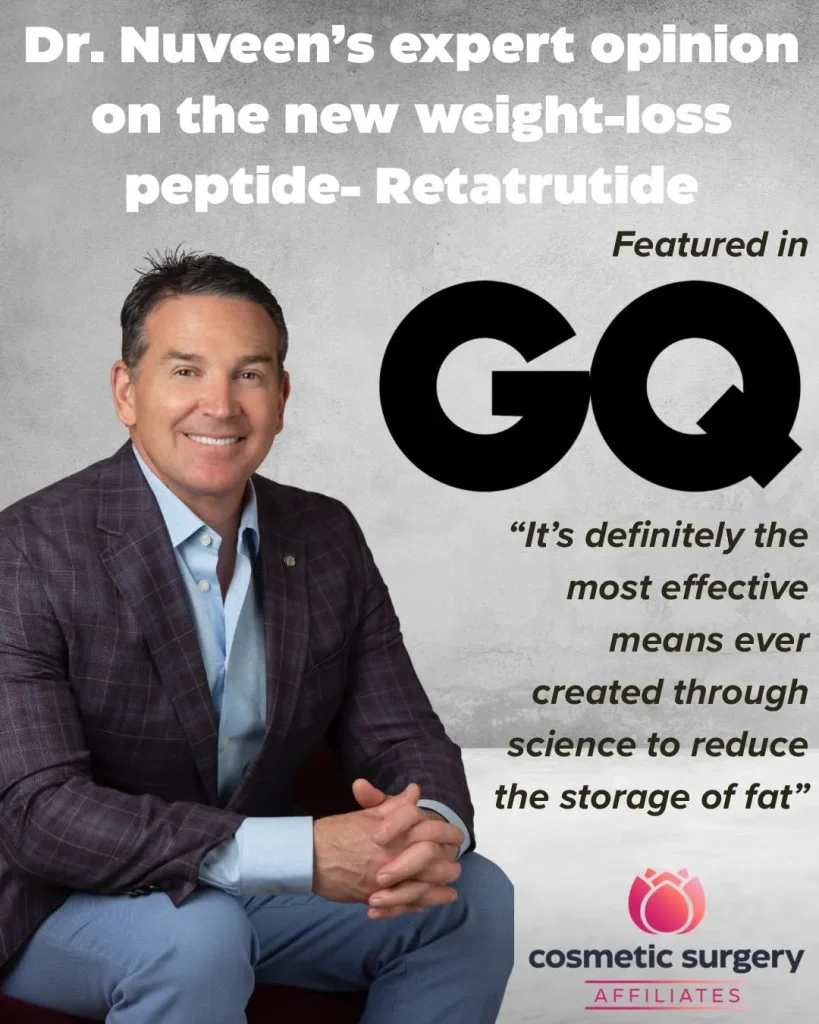
If you follow anything in the fitness or longevity space right now, you’ve probably heard the word retatrutide. People are calling it “reta.” Andrew Huberman is posting about it. Influencers are stacking it. GQ reached out to me to weigh in on what it is and what it actually does, and I want to expand on that here, because there’s more to the story than the hype.
I’ve spent over two decades treating patients with obesity and metabolic disease. I’ve watched this category of medication evolve in real time, from the early GLP-1 work through semaglutide, and then through tirzepatide. Each step mattered. Retatrutide, if it delivers what the Phase 2 and early Phase 3 data suggest, may be the biggest step yet.
First, a Quick History of How We Got Here
Understanding retatrutide requires understanding the progression that led to it.
Semaglutide, the active ingredient in Ozempic and Wegovy, works by targeting a single receptor: GLP-1. It suppresses appetite, slows digestion, and improves insulin sensitivity. For many patients looking for GLP-1 receptor agonist treatments for obesity, it works well. But it’s a single-pathway approach.
Then came tirzepatide. As I explained to GQ, with tirzepatide they added a second feature, which was essentially better management of glycogen. By targeting both GLP-1 and GIP receptors, tirzepatide improved blood sugar control and drove greater weight loss than single-agonist drugs. That was a meaningful advancement for patients who hadn’t gotten the results they needed from semaglutide alone.
Retatrutide takes it a step further. It adds a third target: the glucagon receptor.
What the Glucagon Receptor Actually Does
This is where retatrutide gets interesting. The glucagon receptor works primarily on the liver, in the gastrointestinal tract, and on fat tissue itself. When that third pathway is activated alongside GLP-1 and GIP, you’re addressing weight loss from multiple angles at once: appetite suppression, blood sugar regulation, and increased energy expenditure through enhanced fat metabolism.
Phase 2 trial results published in the New England Journal of Medicine showed participants losing up to 17.5% of their body weight at 24 weeks. Early Phase 3 data from the TRIUMPH-1 trial showed average weight loss of around 28% over 80 weeks on the highest dose. To put that in context, results like that have historically only been associated with bariatric surgery. That’s not a small number.
What We Don’t Know Yet
Retatrutide is not FDA-approved. It is currently in Phase 3 clinical trials. The early data is genuinely impressive, but impressive early data is not the same thing as a proven, approved treatment.
What we don’t yet have is the full long-term safety profile. What we don’t know is how the third receptor pathway behaves over years, not months. We also don’t have firm answers on muscle mass preservation, which matters considerably in the context of large-scale fat loss or body plastic surgery. Any significant weight loss approach, whether surgical or pharmacological, has to account for what’s happening to lean body mass. The best Oklahoma city plastic surgeons plan around that balance from day one, not as an afterthought.
There are also products circulating online that claim to be retatrutide. They are not. The actual compound is only available to participants in Eli Lilly’s clinical trials. Anything sold outside of that is unregulated, unverified, and carries real risk.
Why This Still Matters Right Now
Even though retatrutide isn’t available yet, it matters that patients and providers understand what it is and where it’s headed. Weight management is not one-size-fits-all. Some patients do well with lifestyle and dietary intervention. Some patients benefit from pharmacological support. Some patients reach a point where body lifting surgery is the most appropriate path forward. Our overview of reshaping your body after weight loss covers what to expect from the surgical side of that spectrum. That entire spectrum continues to evolve, and retatrutide is likely going to be part of it.
At CSA and across Olympus Cosmetic Group, we think about weight management in a comprehensive way. Body composition, metabolic health, and cosmetic outcomes are all connected. When someone loses a significant amount of weight, there are often downstream considerations, including loose skin removal for body contouring, that require a surgical perspective.
This is a space worth watching closely. When retatrutide is approved and available through legitimate clinical channels, it will be worth a serious conversation with your physician or with one of our Board Certified Cosmetic Surgeons about whether it’s right for your situation.
Dr. Nuveen spoke with GQ as part of their feature on retatrutide and the rise of next-generation weight-loss peptides. Read the full article here.