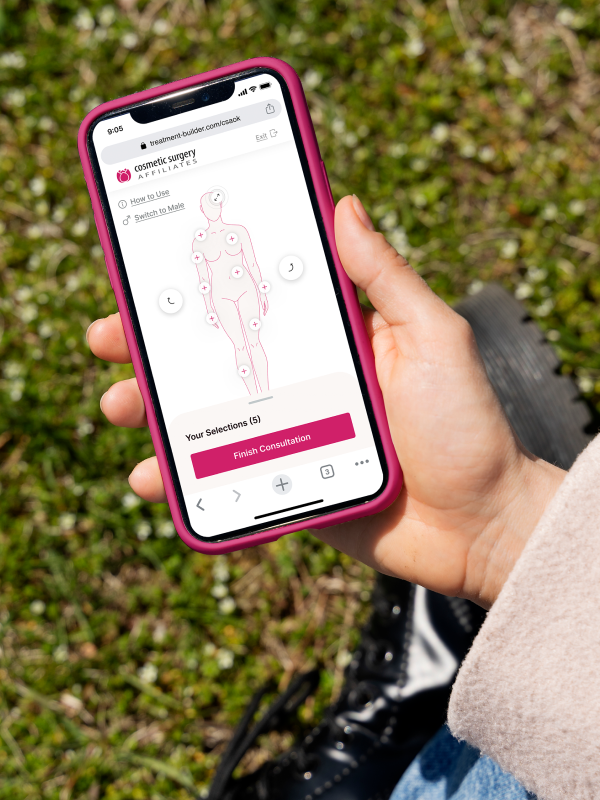

Deciding to change something about your body usually takes time. Many of our patients tell us they researched their options for months, revisited the idea more than once, and started a contact form before setting it aside. That back and forth is a normal part of the process, and it tends to reflect a need for more information rather than any real uncertainty about what you want.
Cosmetic breast augmentation is one of the most popular cosmetic surgeries in the United States, with over 300,000 procedures in the US alone and more than 1.6 million worldwide (ISAPS, 2024). Yet despite its popularity, the decision feels deeply personal and sometimes overwhelming.
At Cosmetic Surgery Affiliates in Oklahoma City, we believe informed patients make the best decisions about their bodies, which is why we’ve created this complete guide.
Let us walk you through everything you need to know: what breast augmentation actually involves, your options, and what recovery feels like. By the end, you’ll have the clarity to decide if this procedure aligns with your goals.
5 Things You Should Know About Breast Augmentation
- Breast augmentation is not just about “going bigger”. It enhances breast size, shape, and symmetry using implants or fat transfer
- Recovery is manageable for most people, with many returning to work within one to two weeks
- Modern breast implants are FDA-approved and designed to look and feel natural when properly selected
- Results depend on your starting anatomy, implant selection, and working with an experienced, board-certified surgeon
- You’re in control of every decision throughout the process, from implant type to size to timing
What exactly is breast augmentation, and is it right for everyone?

Breast augmentation is a surgical procedure that uses breast implants or fat transfer to enhance the size, shape, or symmetry of your breasts. For patients preferring their own tissue, board certified fat transfer surgeons offer a natural alternative to implants. It’s one of the most customizable cosmetic procedures available, and contrary to popular belief, it’s not just about making breasts larger.
The procedure serves different purposes for different people. Some women want to restore volume lost after pregnancy or breastfeeding. Others seek to correct asymmetry where one breast is noticeably larger than the other. Still others simply want their breasts to better match their body proportions or personal aesthetic goals.
It’s important to understand that breast augmentation addresses volume and shape, but it doesn’t correct severe sagging. If your breasts have lost significant firmness or position, you might need breast lift surgery either alone or combined with augmentation. Your surgeon can help you determine the right approach during your consultation.
How do I know if I’m a good candidate for breast augmentation?

Being a good candidate starts with good overall health. You should be physically healthy with no active infections, untreated medical conditions, or serious pre-existing health issues that could interfere with surgery or healing. Equally important is understanding what breast augmentation can and cannot do, for example, it enhances size, shape, and symmetry but does not correct significant sagging, which may require a breast lift.
The FDA has specific age requirements for breast implants: you must be at least 18 years old for saline implants and at least 22 years old for silicone gel implants. These requirements exist because your body and breasts need to be fully developed before augmentation.
Ideal candidate characteristics:
- In good overall physical and mental health
- Not currently pregnant or breastfeeding
- Looking to improve breast size, shape, or symmetry
- Finished having children (recommended but not required, as pregnancy can affect results)
- Non-smoker or willing to quit 4–6 weeks before and after surgery
- Free from active breast infections or untreated breast cancer
For patients planning families, our breast augmentation and breastfeeding guide covers what to know about timing and surgical choices.
The only way to truly determine if you’re a good candidate is through a consultation with a board-certified cosmetic surgeon. They’ll evaluate your specific anatomy, discuss your goals, review your medical history, and provide honest guidance about whether breast augmentation can deliver the results you’re hoping for.
What are my options—saline or silicone?
When it comes to breast implants, you have two main FDA-approved options: saline implants and silicone gel implants. Each has distinct characteristics that affect how they look, feel, and function.
Saline implants are filled with sterile saltwater. They’re typically inserted empty and filled once they’re in position, which allows for a smaller incision. If a saline implant ruptures, your body safely absorbs the saltwater and the implant deflates noticeably.
Silicone gel implants come pre-filled and are the most popular choice today. A variation called form-stable (or ‘gummy bear’) implants uses a thicker, more cohesive silicone gel that maintains its shape.
Most people feel they look and feel more like natural breast tissue compared to saline.The cohesive gel is designed to stay contained within the implant shell. Your surgeon monitors for any changes with routine imaging to ensure everything looks great.
| Feature | Saline Implants | Silicone Gel Implants |
|---|---|---|
| Feel | Firmer, less natural feel | Softer, more like natural breast tissue |
| FDA Age Requirement | 18+ | 22+ |
| If Rupture Occurs | Body absorbs harmless saltwater, deflates noticeably | Silicone gel stays in place or leaks slowly |
| Incision Size | Smaller (filled after insertion) | Larger (pre-filled) |
| Common Use | Less common today | Most popular choice |
You may also come across “gummy bear” implants in your research. These are a type of silicone implant made with a thicker, more cohesive gel that holds its shape even if the shell is compromised. Some surgeons offer this option, so it’s worth asking about during your consultation if you’re curious.
Expert guidance is key when choosing between these options. Our patient Kaitlyn found this to be true during her selection process:
“Last year Dr. Meyer performed my breast augmentation. She recommended going up one more size and the best placement for me. I am so grateful for her knowledge and expertise! They look and feel so natural!
Where do implants go, and does placement really matter?
Breast implants can be placed in two main locations in your chest, and the choice significantly affects your results, recovery, and long-term outcomes. The two options are subglandular (over the chest muscle, under the breast tissue) and submuscular (under the pectoralis chest muscle).
About 50-60% percent of breast augmentations use submuscular placement because it offers several advantages. Studies show this placement results in lower rates of capsular contracture (hardening around the implant), allows for easier mammogram screening, and often produces more natural-looking results, especially for women with minimal natural breast tissue.
Placement considerations:
Submuscular (under chest muscle):
- Creates a more natural appearance for patients with minimal natural breast tissue coverage
- Lower risk of capsular contracture
- Allows easier, more accurate mammogram screening
- Slightly longer, more uncomfortable recovery due to muscle involvement
- Better coverage of implant edges, reducing visible rippling
Subglandular (over muscle, under breast tissue):
- Shorter, less painful recovery period
- Better option for patients with adequate natural breast tissue coverage
- May show implant rippling or edges in patients with minimal natural breast tissue
- Slightly higher risk of capsular contracture
- Can make mammogram screening more challenging
Your surgeon recommends placement based on several factors: your body type, the amount of natural breast tissue you have, the size of implant you’re choosing, your lifestyle and activity level, and your personal goals. There’s no universally “best” placement—only what’s best for your specific situation.
How is the surgery actually performed, and what incision will I have?
Breast augmentation surgery is typically performed under general anesthesia in an accredited surgical facility. The procedure usually takes one to two hours, though it may take longer if you’re combining it with other procedures like a breast lift.
Your surgeon makes an incision in one of several locations, creates a pocket for the implant (either above or below the chest muscle), inserts the implant, and then closes the incisions with layered sutures. The location of your incision affects both your scarring and your surgeon’s access during the procedure.
Common incision locations:
- Inframammary (breast crease): The most common approach, used in 70 to 80 percent of procedures. The incision is made in the natural fold under your breast, where scars are easily hidden. This location provides excellent access and control for implant placement.
- Periareolar (around the areola): The incision follows the lower edge of your areola. Scars blend well with the color change between areola and skin. May slightly increase risk of affecting milk ducts or nipple sensation.
- Transaxillary (armpit): The incision is made in your armpit, leaving no scars on the breast itself. This approach limits the types of implants that can be used and makes revisions more challenging.
- Transumbilical (belly button): Rare technique where the incision is made in your belly button. Only suitable for saline implants (which can be filled after insertion) and technically challenging, limiting surgeon options.
After placing the implant, your surgeon closes the incisions with multiple layers of sutures in the breast tissue and then closes the skin with sutures, skin adhesive, or surgical tape. Over time, typically six months to two years, your incision lines will fade significantly. The quality of your scarring depends on factors including your genetics, how well you follow post-operative care instructions, and whether you avoid nicotine exposure.
What does recovery really feel like day by day?
Recovery from breast augmentation is gradual, with noticeable improvements happening week by week. While everyone heals at their own pace, understanding the general timeline helps you plan time off work, arrange help at home, and set realistic expectations about when you’ll feel like yourself again.
| Timeline | What to Expect | Activity Level |
| First 24–48 hours | Peak discomfort and swelling. Breasts feel very tight and sit high on the chest. Extreme fatigue from anesthesia. | Rest only. Light walking around the house every few hours to prevent blood clots. No lifting, reaching, or upper body movement. |
| Days 3–7 | Moderate soreness, transitioning from prescription to over-the-counter pain medication. Swelling and bruising present but improving. Breasts still appear high and larger than expected. | Many return to desk jobs by day 5–7. No lifting anything heavier than 5 pounds. Light daily activities are okay. Avoid raising arms above shoulders. |
| Weeks 2–3 | Significant improvement in comfort. Most swelling is decreasing. Stitches removed if non-dissolvable. Breasts begin to “drop and fluff” into a natural position. Transition from surgical bra to supportive sports bra. | Light daily activities resumed. Still avoid heavy lifting, strenuous exercise, and activities that raise heart rate significantly. Can typically drive once off narcotic pain medication. |
| Weeks 4–6 | Most swelling would be resolved. Breasts settling into a more natural position and shape. Scars healing and beginning to fade. Significantly more comfortable in the body. | Cleared for full exercise around week 4–6 based on surgeon approval. Gradual return to fitness routine. Start with cardio, then add upper body exercises slowly. |
| Months 3–6 | Final “drop and fluff” settling occurs. Implants fully in natural position. Swelling completely resolved. Scars continue to fade (will continue improving up to 18–24 months). | Full activity without restrictions. Most patients see their final results by 3–6 months, though subtle changes continue up to one year. |
Proper scar care can significantly improve how your incisions heal. Your surgeon will provide specific instructions, and we offer medical-grade skincare products formulated to support scar healing and skin recovery if you’d like additional support.
What are the risks, and how common are complications?
Like any surgery, breast augmentation carries potential risks and complications. While serious complications are rare when the procedure is performed by a board-certified surgeon in an accredited facility, it’s important to understand what can happen so you can make an informed decision and recognize warning signs if they occur.
Potential risks and complications:
- Capsular contracture: Your body naturally forms a capsule of scar tissue around any implant. In some cases, this capsule becomes thick and tight, causing the breast to feel hard, look distorted, or cause discomfort. This is the most common complication, with a lifetime risk of 8–12% for submuscular placement and 12–18% for subglandular placement. Treatment usually requires surgical intervention.
- Implant rupture or leakage: All implants can eventually rupture. Saline implants deflate noticeably and the saltwater is safely absorbed by your body. Silicone gel implants use cohesive gel designed to stay in place. Routine MRI or ultrasound monitoring helps detect any changes early, and your surgeon can discuss management options during regular follow-up visits. Modern implants typically last 10–20+ years, though some last much longer.
- Changes in nipple or breast sensation: Temporary numbness, tingling, or hypersensitivity is common and usually resolves within 6–12 months. “In rare cases (less than 5%), some changes in nipple sensation may be longer-lasting. Your surgeon discusses sensation risks during your consultation and takes careful steps during the procedure to protect nerve pathways.
- Infection: Rare when proper sterile technique is used and antibiotics are administered. Occurs in approximately 1–2% of cases. Signs include fever, unusual warmth, redness, or discharge from incisions. Your surgical team provides clear guidelines on what to watch for, and infections caught early are typically resolved quickly with targeted treatment.
- Implant malposition: The implant shifts from its intended position, causing asymmetry or unnatural appearance. May occur due to inadequate pocket creation, capsular contracture, or trauma. Often requires revision surgery to correct.
- Asymmetry or unexpected aesthetic outcome: Breasts may heal differently, or results may not match your expectations. Minor asymmetry is common; significant issues may require revision surgery.
Board-certified surgeons minimize your risk through meticulous surgical technique, sterile operating environments, proper implant selection for your anatomy, comprehensive pre-operative screening, and detailed post-operative care instructions. Following your surgeon’s guidelines carefully also significantly reduces complication risk.
What happens during my consultation, and how do I prepare?
Your consultation is your opportunity to ask questions, see examples of the surgeon’s work, learn about your options, and determine if the surgeon is the right fit for you. This isn’t just a chance for the surgeon to evaluate you, it’s equally your chance to evaluate them.
During your consultation at CSA, we’ll walk you through every option, help you visualize potential results using sizing tools, and answer every question you have, no matter how small it seems. We want you to leave feeling informed and confident about your decision.
Whether you are local or traveling, the consultation sets the tone.
Emily’s experience shows how we bridge that gap:
“I had breast augmentation surgery with Dr. Nuveen and Dr. Meyer a month ago. I had done a virtual consultation previously since I was coming from another state… Both were wonderful!
How much does breast augmentation cost, and what affects the price?
Breast augmentation is a significant financial investment, with costs varying widely based on multiple factors. At Cosmetic Surgery Affiliates, our cosmetic surgery clinic in Oklahoma city offers breast augmentation ranging from $6,500 to $9,500 depending on your individual needs and the options you choose.
Factors that affect cost:
- Surgeon’s experience, reputation, and skill level
- Geographic location
- Type of implants chosen
- Surgical facility fees
- Anesthesia fees
- Pre-operative testing and post-operative supplies
- Additional procedures performed simultaneously
Insurance rarely covers breast augmentation when it’s performed for cosmetic reasons. However, insurance may cover breast reconstruction after mastectomy for cancer treatment or reconstruction after significant trauma or congenital deformities. Check with your insurance provider for specific coverage details.
How do I take the next step if I’m interested?
Deciding to explore breast augmentation is deeply personal, and there’s no “right” timeline for making this choice. Some women research for months or even years before scheduling a consultation. Others feel ready after a few weeks of consideration. What matters is that you feel informed and confident when you move forward.
Your next steps:
- Research board-certified surgeons in your area
- View before-and-after photo galleries to see results from different surgeons
- Read patient reviews on Google and other platforms to understand others’ experiences
- Schedule consultations with two to three surgeons to compare their approaches and recommendations
- Prepare your list of questions and any photos of results you admire
- Take time after consultations to think, discuss with trusted friends or family, and reflect on your goals
- When ready, schedule your surgery and begin preparation according to your surgeon’s guidelines
Our team at Cosmetic Surgery Affiliates offers both in-person and virtual consultations to discuss your goals and answer every question you have. We’ll help you determine if breast augmentation aligns with what you’re hoping to achieve, explore your options, and create a personalized plan based on your unique anatomy and aesthetic vision.
Conclusion
Breast augmentation is a highly customizable procedure that can enhance your confidence and help you feel more comfortable in your own body when performed by a qualified, experienced surgeon. The key to satisfaction lies in thorough research, understanding what the procedure can achieve for your unique anatomy, and choosing a board-certified surgeon.
Whether you’re ready to schedule a consultation or simply want to learn more, Cosmetic Surgery Affiliates in Oklahoma City is here to support you with expert guidance, honest answers, and compassionate care. We believe every patient deserves to feel heard, respected, and confident in their choices.
Disclaimer – This content is for educational purposes only and does not constitute medical advice. A consultation with a qualified board-certified surgeon is required to determine the best treatment plan for your individual needs and any questions you may have about a medical condition or procedure.
Frequently Asked Questions
How long does breast augmentation surgery take?
Most breast augmentation procedures take one to two hours under general anesthesia. The timing can be longer if you’re combining augmentation with a breast lift or other procedures.
When can I go back to work after breast augmentation?
Most patients with desk jobs return to work within five to seven days. If your job requires heavy lifting, strenuous activity, or significant upper body movement, you may need two to three weeks or more.
Will breast implants feel natural?
Silicone gel implants feel most like natural breast tissue, especially when placed under the chest muscle. How natural your implants feel also depends on your starting anatomy, the implant size chosen, and how much natural breast tissue you have.
How do I know what size implants to get?
Your surgeon helps you choose based on your body measurements, existing breast tissue, chest width, and aesthetic goals. Many practices offer sizing tools, sample implants, or simulation software during consultation to help you visualize different volumes on your specific frame.
Are there benefits for patients considering multiple procedures at CSA?
If you’re planning breast augmentation along with other cosmetic treatments, or want access to ongoing aesthetic services, our membership program offers exclusive pricing and benefits that can provide significant value for comprehensive aesthetic care.