
Implant size tends to be the decision patients spend the most time on, and often the one that causes the most second-guessing. Comparison charts, cup-size conversions, and before-and-after photos from other patients all offer partial answers, but none of them account for the variables that actually determine your result.
Volume in cubic centimeters doesn’t translate cleanly to a cup size. The same 300cc implant produces noticeably different outcomes depending on chest width, existing breast tissue, implant profile, and placement. That’s also why the current emphasis in aesthetic surgery has shifted toward proportion and fit rather than size alone.
According to ISAPS’s 2024 Global Survey, 227,470 breast augmentations were performed in the U.S. alone, making it the second most popular surgical cosmetic procedure for women nationwide.
At Cosmetic Surgery Affiliates in Oklahoma City, we find that the happiest patients are those who understand that sizing is a science of dimensions, not just a shopping list. This guide covers everything from how CCs translate to cup sizes, to why implant profile matters as much as volume, to how to prepare for a consultation that puts you in control.
5 Things to Know Before Choosing Your Implant Size
- Breast implant size is measured in cubic centimeters (CCs), not cup sizes, and roughly 150 to 200cc equals one cup size increase.
- Your chest wall width is the most important measurement your surgeon will take, because an implant that’s too wide for your frame causes problems regardless of how good the volume looks.
- Implant profile, meaning how far the implant projects from your chest, matters just as much as volume, and two implants with the same CCs can look completely different based on profile.
- Modern round implants settle into a natural teardrop shape with gravity, so the idea that round automatically looks fake is largely a myth.
- The full settling process, called drop and fluff, takes three to six months, so your results right after surgery aren’t your final results.
Why Can’t I Just Order a “Full C-Cup”?
It’s the first question nearly every patient asks: can I just get a full C? The short answer is no, and here’s why.
Cup sizes aren’t standardized. A C-cup at one bra brand is a D at another and a B at a third. That’s why surgeons measure breast implant size in cubic centimeters (CCs), which is an exact, universal measurement of volume.
As a general rule, every 150 to 200cc of added volume equals roughly one cup size increase. But even that’s an estimate, because your starting breast tissue, chest width, and body proportions all influence how a specific CC amount actually looks on you.
| Implant Volume | Approx. Cup Size Increase | Visual Impact |
| 150-200cc | ~1 Cup | Subtle, natural enhancement |
| 250-350cc | ~2 Cups | Noticeable, clearly fuller |
| 375-500cc | ~2-3 Cups | Significant, dramatic change |
| 500cc+ | 3+ Cups | Very dramatic, lifestyle consideration |
Once you understand that CCs are your real measuring tool, the next question becomes how that volume gets distributed on your body, and that’s where the implant profile comes in.
What Is an Implant “Profile,” and Why Does It Matter as Much as Size?
Profile is one of those terms that doesn’t mean much until your surgeon explains it, and then suddenly everything clicks. It refers to projection, or how far the implant extends outward from your chest wall.
Think of it this way. Picture a tall, thin glass next to a short, wide bowl. Both hold the same amount of water, but the shapes are completely different. That’s the difference between a high-profile implant and a low-profile implant with the same CCs.
High-profile implants project more and sit narrower on the chest. Low-profile implants spread wider and project less. Moderate-profile falls somewhere in between.
- Low profile: Wider base, less projection, best for subtle enhancement on broader chests
- Moderate profile: Balanced width and projection, the most versatile option for a range of chest dimensions
- High profile: Narrower base, more projection, ideal for patients with a narrower chest wall who want significant volume
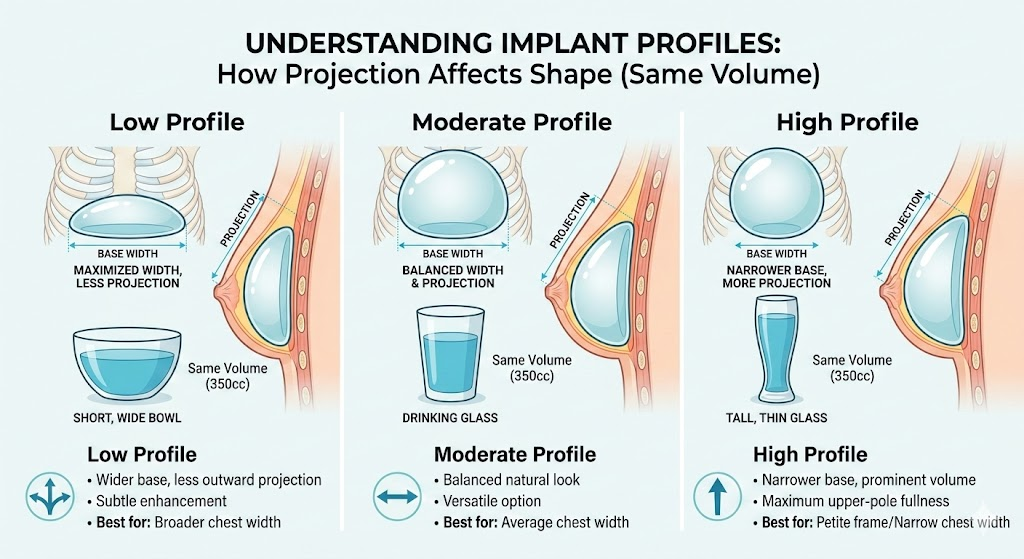
Here’s a practical example. If you have a narrow chest and want 350cc of volume, a high-profile implant lets you achieve that fullness without the implant appearing too wide on your frame. Your surgeon will match the profile to your chest width during your consultation.
Profile and volume work as a pair, so understanding both gives you a much clearer picture of what your results will actually look like. The next factor in that equation is shape.
Round vs. Teardrop: Which Shape Gives the Most Natural Result?
If you’re worried about looking “bolted on,” you’re not the only one. It’s one of the most common fears patients bring into a consultation, and it’s worth addressing directly.
Here’s the good news. The idea that round implants automatically look fake is largely a myth. Modern cohesive gel round implants respond to gravity, which means they settle into a teardrop shape when you stand and look rounder when you lie down, just like natural breast tissue.
Teardrop (anatomical) implants are designed to mimic the natural breast slope, with more volume concentrated in the lower half. They can produce beautiful results, but they come with a trade-off. Because teardrop implants have a distinct top and bottom, in rare cases, they can shift position. If that happens, the breast shape may look slightly uneven, though your surgeon can correct this if needed.
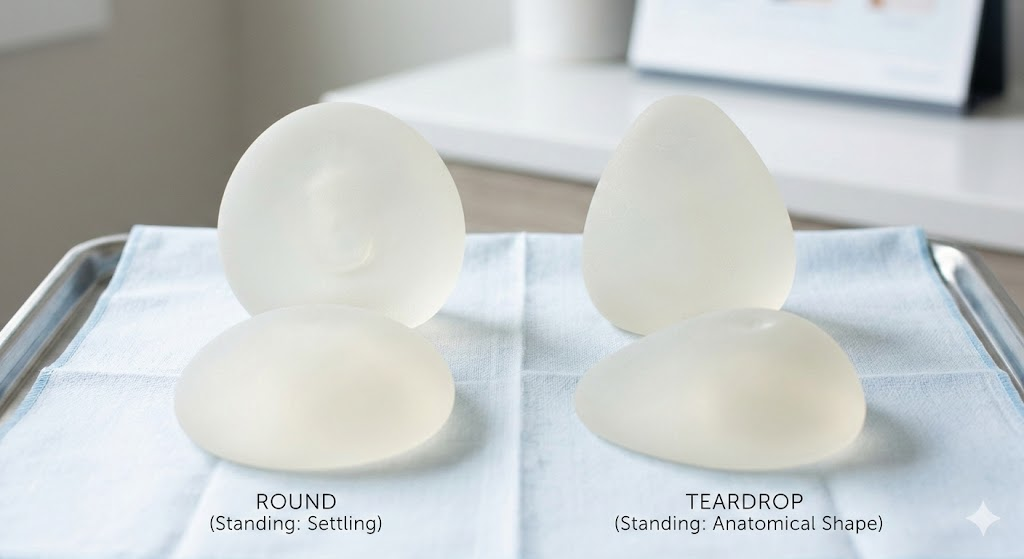
Choosing between round and teardrop isn’t about which is better. It’s about which matches your anatomy and goals. Many patients experience challenges when trying to correct past procedures to finally get the shape they want.
This is exactly what happened with our patient, Brooks:
“Dr. Meyer is literally a miracle worker!! I went to her after 24 years of implants, the last being a horrible botched job 9 years ago. She patiently listened to my concerns and went over her 2 step surgical plan to give me the boobs I have always wanted.”
Your surgeon will recommend a shape based on your chest dimensions and desired outcome. Speaking of dimensions, your natural anatomy plays a bigger role in size selection than most patients expect.
How Does My Natural Anatomy Limit Your Size Options?
It’s easy to walk into a consultation with a number in mind, only to learn that your body has its own vote. Your natural anatomy is the starting point for every sizing decision, and understanding why helps you feel confident rather than restricted.
The most important measurement is your breast base width, which is the natural width of your breast from side to side. An implant that’s wider than your base width can cause rippling, visible edges, or even symmastia, a rare condition where implants migrate toward each other, which is why precise measurements matter so much.
Our team at Cosmetic Surgery Affiliates takes detailed measurements during your consultation to ensure the implant fits within your natural footprint, so the result looks like it belongs on your body.
- Chest wall width determines the maximum implant diameter your frame can support
- Skin elasticity affects how much volume your tissue can comfortably hold
- Existing breast tissue influences how the implant sits and feels against your body
- Body frame and height affect how a given CC volume appears proportionally
Once your surgeon has mapped your dimensions, the next consideration is implant material, because the type of implant you choose also affects how your size looks and feels.
Does Implant Material Affect the Way Your Size Looks?
The short answer is yes. The material inside your implant influences how it feels, how it moves, and how natural it looks on your body. Each type has distinct advantages worth understanding.
| Type | FDA Age Requirement | Pros | Cons |
| Saline | 18+ | Adjustable volume, smaller incision, absorbed by the body if ruptured | More rippling risk, firmer feel |
| Silicone | 22+ | Natural feel, less rippling, most popular choice | Requires routine imaging to confirm integrity |
Silicone implants account for the vast majority of breast augmentations in the U.S., largely because they feel closest to natural breast tissue. Saline implants are FDA-approved for women 18 and older, while silicone gel implants, including cohesive gel (gummy bear) options require patients to be at least 22 (FDA).
For a full comparison of how implant material affects appearance, see our implant types guide. The material you choose interacts with your size and profile selections, so it’s worth discussing all three together with your surgeon.
What Is the “Rice Test” and Can It Help You Decide?
If you’ve spent any time researching breast implant size online, you’ve probably come across the rice test. It’s a simple at-home method that lets you approximate what different implant volumes might look and feel like before your consultation.
Here’s how it works:
- Measure one cup of dry rice, which equals approximately 236cc
- Place the rice in a knee-high stocking or cut section of pantyhose
- Tie the end and tuck the sizer into a snug sports bra or tight white tank top
- Adjust the amount of rice up or down to test different volumes
- Evaluate the look and feel in front of a mirror
But here’s the thing. The rice test shows you volume and weight only. It can’t simulate projection, shape, or how the implant will interact with your chest width and tissue. So treat it as a starting point for conversation, not a final decision.
It’s completely normal to have a change of heart as you explore your options further, which is exactly what our patient Cynthia experienced:
“I chose Dr. Caplin to do my surgery and met with her right before because I had a change of mind and wanted to increase my implant size last minute. She was very open and helpful with this. I took in her advice and I was able to decide on what larger implant I wanted. She never made me feel like a pain and listened to what I wanted and gave me what I wanted. Looked through photos with me and discusses options.”
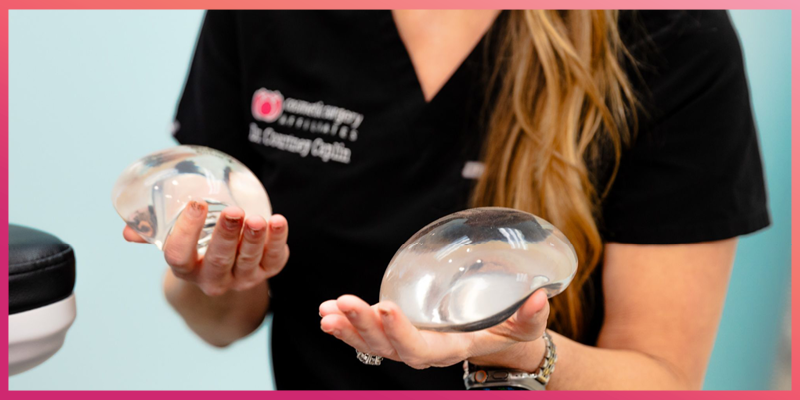
Professional sizers at your surgeon’s office are the closest you’ll get to previewing your actual results. They account for projection and shape in ways the rice test simply can’t, which is why the in-office try-on is so valuable.
Will Your Implants Look “Too High” Right After Surgery?
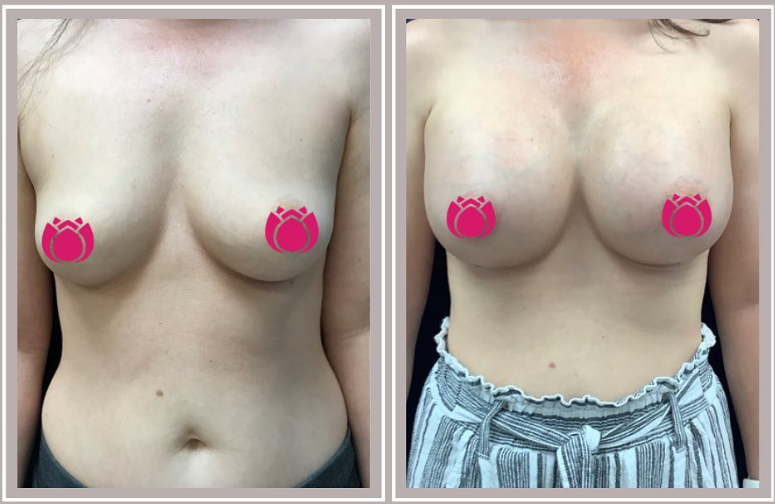
If you’ve seen photos of fresh post-op results and thought “those look way too high,” that’s completely normal, both the look and the reaction. Immediately after surgery, implants sit higher on the chest because the surrounding muscle and tissue haven’t relaxed yet.
This settling process is called drop and fluff, and it happens gradually over several months. The “drop” refers to the implants moving downward into their final position, and the “fluff” describes the tissue softening and the shape filling out naturally.
| Timeframe | Appearance | Sensation |
| Week 1-3 | Very high, firm, may appear cone-shaped | Tight, heavy, pressure sensation |
| Week 4-6 | Starting to drop, upper fullness softening | Improving, occasional muscle soreness |
| Month 2-3 | Shape becoming more natural | Much softer, minimal discomfort |
| Month 3-6 | Final position, natural teardrop shape | Full sensitivity returning, fully settled |
Sound familiar to you?
Many patients experience a wave of post-op buyer’s remorse during the first few weeks, convinced something went wrong. It almost never has. Your surgeon will monitor your progress at follow-up appointments to confirm everything is settling as expected.
For the full drop and fluff timeline and what your results will look like after settling, see our results article. Most patients say the moment everything clicks into place, usually around month three, is when the excitement really hits.
What Are the Risks of Choosing a Size That Is Too Big?
Bigger isn’t always better, and a responsible surgeon will tell you that directly. Reading a list of potential complications can feel intimidating, but understanding these risks is actually one of the most empowering things you can do before surgery.
Implants over 400cc, particularly for patients with a narrower chest wall or less tissue coverage, carry specific long-term risks that are worth understanding before you commit.
- Larger implants may place additional demands on skin and tissue
- Back and neck pain, especially for patients with less natural tissue coverage
- Visible rippling and tissue thinning as the skin stretches to accommodate the volume
- Limitations on certain athletic activities and exercise routines
- Potential need for earlier revision surgery compared to moderately sized implants
Our expert breast augmentation team at Cosmetic Surgery Affiliates will be honest if a requested size compromises your safety or tissue health. We prioritize long-term results over short-term volume, because your results should still look and feel great 10 years from now.
Understanding these risks isn’t meant to scare you. It’s meant to help you make a choice you’ll love for years, not just months. And that brings us to the practical side of the decision: cost.
How Much Does Breast Augmentation Cost, and Can You Finance It?
Cost is a real factor in this decision, and there’s no shame in asking about it early. We know the financial side can feel stressful, especially when you’re already making a big personal decision.
Breast augmentation pricing varies by implant type (silicone generally costs more than saline), surgical complexity, and geographic location. At Cosmetic Surgery Affiliates, breast augmentation ranges from $6,500 to $9,000. Your exact quote is determined during your consultation after your surgeon evaluates your anatomy and goals.
Learn more about how implant size affects the total cost in our cost breakdown guide.
We also offer flexible financing options through Cherry, Alphaeon, and PatientFi, making it easier to plan your procedure on a timeline that works for your budget.
How Should You Prepare for Your Sizing Consultation?
Your sizing consultation is where everything comes together, and walking in prepared makes a huge difference. This isn’t just a chance for the surgeon to evaluate you. It’s equally your chance to evaluate them.
- Bring “wish pics” (results you love) AND “nightmare pics” (results you want to avoid)
- Wear a tight, white tank top so you can see sizer shape clearly under fabric
- Bring bras in the sizes you’re considering so you can see how sizers fill them
- Write down your questions, including concerns about profile, shape, and recovery
- Be open about your lifestyle, including exercise habits and clothing preferences
At Cosmetic Surgery Affiliates, our patient Jordan’s experience is a great example. She tried on every size available until she felt completely confident in her choice. That kind of unhurried, thorough approach is exactly what a good sizing consultation looks like:
“I had a consultation for a breast augmentation in March. The consultation was thorough! We discussed my hopes/goals, different types of implants, different methods of placement, and I got to try a bunch of implant sizes until I decided on a size I felt the best with. The nurse practitioner made sure to answer all of my questions and made me feel so reassured throughout the whole process.“
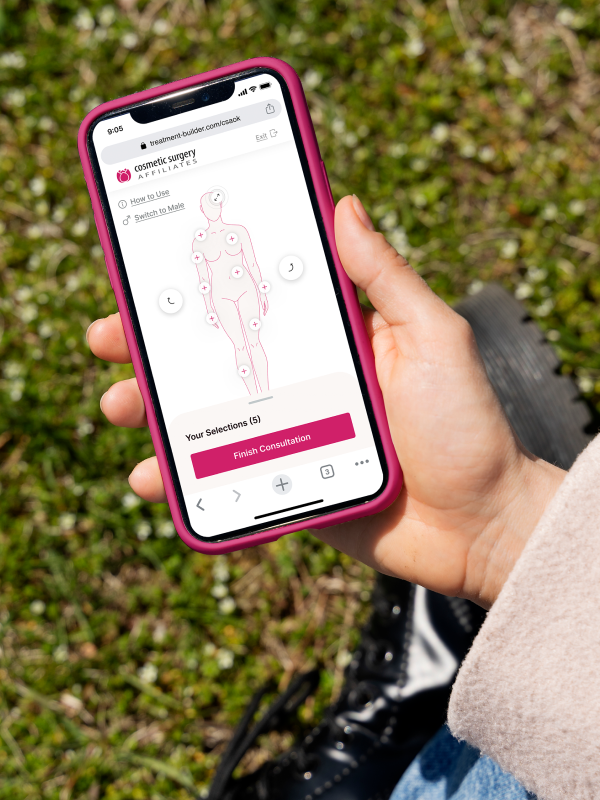
If you’re out of town or want to start the process from home, you can begin with an online consultation. It’s a convenient way to share your goals and get initial guidance before scheduling an in-person visit.
Conclusion
The “right” breast implant size isn’t a number you find online. It’s a decision you make with your surgeon after understanding how CCs, profile, shape, and your natural anatomy all work together. The patients who love their results long term are the ones who prioritize proportion over a specific cup size.
Whether you’re looking for a subtle enhancement or a dramatic change, choosing a cosmetic surgeon in Oklahoma city starts with our board-certified team, here to guide you toward a safe, beautiful result that feels like you. Every patient deserves to feel heard, respected, and confident in their choices.
Frequently Asked Questions
Will breast implants lift sagging breasts?
Implants add volume and fullness, but they don’t lift sagging tissue. If you have significant sagging, your surgeon may recommend combining augmentation with a breast lift for the best result.
Can I breastfeed after getting implants?
Most women can breastfeed after breast augmentation, though some may experience reduced milk production depending on the incision location and surgical technique.
How long do breast implants last?
Breast implants typically last 10 to 20 years before they may need replacement or removal. Your surgeon will monitor them at regular follow-up appointments to catch any changes early.
Is 400cc considered large?
It depends entirely on your body frame. On a narrower chest, 400cc can look quite dramatic, while on a broader chest, it may appear moderate. That’s exactly why CCs only tell part of the story.
Do implants need maintenance?
Silicone implants require periodic MRI screenings to check for silent ruptures, and all implants should be monitored through regular follow-up appointments. At Cosmetic Surgery Affiliates, we schedule ongoing check-ins to ensure everything stays in great shape.
Disclaimer – This content is for educational purposes only and does not constitute medical advice. A consultation with a qualified board-certified surgeon is required to determine the best treatment plan for your individual needs and any questions you may have about a medical condition or procedure.